MFI-15 Safari
Summary
| Category | Military Training Aircraft |
| Origin country | 🇸🇪 Sweden |
| Manufacturer | Saab |
| First flight | 11 July 1969 |
| Year introduced | 1972 |
| Number produced | 462 units |
Technical specifications
| Version: MFI-395 Super Mushshak | |
|---|---|
| Operational range | 700 km (435 mi) |
| Maximum speed | 236 km/h (147 mph) |
| Wing area | 11.9 m² (128.1 sqft) |
| Wingspan | 8.9 m (29.0 ft) |
| Height | 2.6 m (8.5 ft) |
| Length | 7.2 m (23.5 ft) |
| Service ceiling | 6,706 m (22,001 ft) |
| Empty weight | 760 kg (1,676 lbs) |
| Max. takeoff weight | 1,250 kg (2,756 lbs) |
| Climb rate | 8.6 m/s (28.2 ft/s) |
| Powerplant | 1 x pistons engine Lycoming IO-540-V4A5 delivering 194 kW each |
Current operating countries
| Country | Units | ||
|---|---|---|---|

|
Pakistan | 359 | |

|
Turkey | 39 | |

|
Denmark | 25 | |

|
Iran | 25 | |

|
Saudi Arabia | 20 | |

|
Norway | 16 | |

|
Zimbabwe | 12 | |

|
Azerbaijan | 10 | |

|
Nigeria | 8 | |

|
Qatar | 8 | |

|
Oman | 7 | |

|
Syria | 6 | |

|
Iraq | 4 (+8) | |
All operators
Description
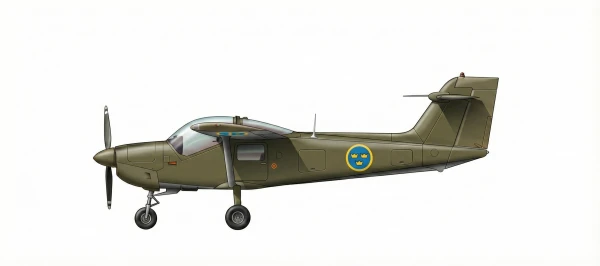
The Saab MFI-15 Safari's development began with the prototype (SE-301), which first flew on 11 July 1969. This two/three-seat civil/military trainer or general utility aircraft was developed at Malmö Flygindustri. The initial prototype was powered by a 119 kW Avco Lycoming IO-320-B2 flat-four engine and featured a conventional low-set tailplane. Later, the tailplane was modified to a T-tail configuration to minimize damage from rough airfields. On 26 February 1971, the prototype flew with the more powerful Avco Lycoming IO-360-A1B6 air-cooled flat-4 piston engine, which became the standard powerplant for the production version, then designated as the Saab Safari. A military version, initially designated Saab-MFI 17, flew on 6 July 1972; this version was later named Saab Supporter.
The Saab MFI-15 Safari is a braced shoulder-wing monoplane distinguished by its fixed tricycle landing gear, with an optional tail-wheel landing gear also available. It features side-by-side enclosed accommodation for two occupants and incorporates dual controls as standard equipment. A notable aerodynamic design element is its forward-swept wings, intentionally designed to ensure the wing root does not obstruct the pilots’ lateral field of vision. The military variant, Saab MFI-17 Supporter, was specifically outfitted for military training, artillery observation, forward air control, and liaison duties. Experience with the earlier MFI 9B Minicom during the Biafran Civil War encouraged development of the Supporter with underwing stores capability, including rockets and gun pods, for use as a light attack aircraft. A variant with a stretched wing made of composite materials, the MFI-18, was tested.
The Royal Danish Air Force acquired 32 Supporters, while the Royal Norwegian Air Force operated 16 Safaris from 1981, stationed at Bardufoss Air Station. The Pakistan Air Force received 28 aircraft directly from Saab, in addition to 92 assembled from knock-down kits. The aircraft also saw service with the Sierra Leone Armed Forces and the Zambia Air Force, with 2 and 20 aircraft respectively.
Main Variants:
-
MFI-15 Safari: This was the original civilian version of the aircraft, serving as a two/three-seat civil/military trainer or general utility aircraft.
-
MFI-17 Supporter: This is Saab's designation for the military variant, specifically equipped for military training, artillery observation, or forward air control and liaison.
-
Saab Safari TS: This was a prototype version of the Safari fitted with a 157 kW (210 hp) turbocharged piston engine, though it did not enter production.
-
MFI-17 Mushshak: This is an improved version of the MFI-17 Supporter, manufactured by Pakistan Aeronautical Complex under license for the Pakistan Air Force.
-
PAC Super Mushshak: This is an upgraded, Pakistan-manufactured variant of the MFI-17 Mushshak, featuring improvements over the original design.