MFI-15 Safari
Swedish utility aircraft, operational since the 1960s, frequently deployed for training and light transport roles worldwide. Key figures: top speed 236 km/h, range 700 km, service ceiling 6,706 m, max takeoff weight 1,250 kg, built 462. In service with 12 air forces as of 2026 — Pakistan (358), Turkey (52), Denmark (25) and 9 others.
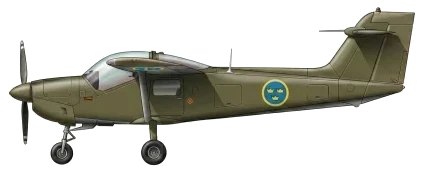
| Length | 7.2 m (23.5 ft) |
| Wingspan | 8.9 m (29.0 ft) |
| Height | 2.6 m (8.5 ft) |
| Wing area | 11.9 m² (128.1 sqft) |
| Empty weight | 760 kg (1,676 lbs) |
| Max. takeoff weight | 1,250 kg (2,756 lbs) |
| Powerplant | 1 × pistons engine Lycoming IO-540-V4A5 194 kW each |
| Maximum speed | 236 km/h (147 mph) |
| Operational range | 700 km (435 mi) |
| Service ceiling | 6,706 m (22,001 ft) |
| Climb rate | 8.6 m/s (28.2 ft/s) |


Recent Events — MFI-15 Safari
2 events →
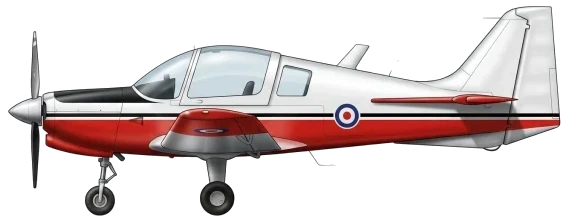
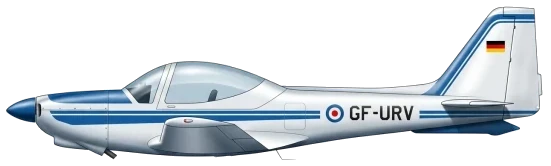
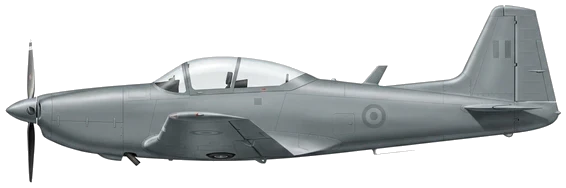
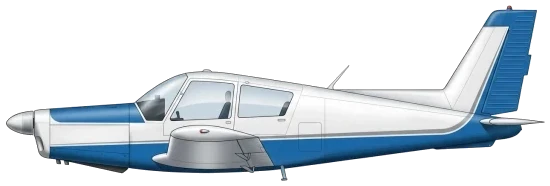
Description
The Saab MFI-15 Safari is a two-seat piston-engined basic trainer produced by Saab in Sweden from the early 1970s. Offered in a military version as the MFI-17 Supporter, it performs training, artillery observation, forward air control, liaison and close support missions. It is best known for its forward-swept high wing and for its Pakistani descendants, the MFI-17 Mushshak and the Super Mushshak, which make it one of the most widespread military training aircraft in the world.
Development
The Saab-MFI 15 prototype (SE-301), developed at Malmö Flygindustri, made its first flight on 11 July 1969 with a 119 kW Avco Lycoming IO-320-B2 engine and a low-set horizontal tail. The latter was subsequently converted to a T-tail configuration to limit damage during operations from rough strips. On 26 February 1971, the prototype flew with the Lycoming IO-360-A1B6, selected as the production engine under the Safari designation. The military MFI-17 version flew on 6 July 1972. In August 1978, Saab tested the Safari TS fitted with a 157 kW turbocharged Continental flat-six, which was not pursued; the MFI-18 with an extended composite wing, tested in the 1980s and intended to carry skis, was not produced either. Saab assembled 250 complete aircraft, mostly sold to private owners; with the 212 Pakistani examples built from CKD kits or locally manufactured, total production reached 462 units.
Design
The Safari is a braced high-wing monoplane, with forward sweep so that the wing root does not obstruct the pilots' sideways view — a solution also adopted on the ARV Super2 and the Bölkow Bo 208 Junior. The fixed tricycle undercarriage can optionally be replaced by a conventional tailwheel undercarriage. The enclosed cabin seats two occupants side by side with dual controls as standard, plus one passenger. The production engine is a 150 kW Lycoming IO-360-A1B6 air-cooled flat-four driving a two-blade Hartzell constant-speed propeller. Empty weight 646 kg, maximum weight 1,200 kg, maximum speed 236 km/h at sea level, ceiling 4,100 m and endurance of 5 h 10 min.
Armament
The MFI-17 Supporter has underwing hardpoints accepting rocket pods and gun pods. Experience gained with the MFI-9B MiniCOIN during the Biafran War led Saab to develop the Supporter as a close support and counter-insurgency aircraft.
Operational History
The Supporter was delivered to the Royal Danish Air Force (32 examples, local designation T-17), the Royal Norwegian Air Force (16 aircraft bought in 1981, now stationed at Bardufoss Air Station) and the Pakistan Air Force (28 aircraft delivered by Saab and 92 assembled from kits). The Sierra Leone armed forces (2) and the Zambian Air Force (20) have also operated it. In 2022, 477 Safari, Mushshak and Super Mushshak aircraft remained in service.
Variants
- MFI-15 Safari: initial civil version.
- MFI-17 Supporter: Saab's military version, designated T-17 in Denmark.
- Saab Safari TS: prototype fitted with a 157 kW turbocharged piston engine, not produced.
- MFI-17 Mushshak: improved version of the Supporter built under licence by Pakistan Aeronautical Complex.
- PAC Super Mushshak: modernised development of the Mushshak of Pakistani production.
Frequently Asked Questions
What type of aircraft is the MFI-15 Safari?
What is the maximum speed of the MFI-15 Safari?
What is the range of the MFI-15 Safari?
When did the MFI-15 Safari first fly?
How many MFI-15 Safari have been built?
Which countries operate the MFI-15 Safari?
What is the service ceiling of the MFI-15 Safari?
- AUG 302026 Updated Description updated
- APR 72026 Updated Sources and cross-references refreshed
- FEB 72026 Updated MFI-15 Safari: top speed added; MFI-15 Safari: range added
- OCT 222023 Updated Specifications and description reviewed