Berlin Tegel Airport
Summary
| Operating Country | 🇩🇪 Germany |
| Location | 🇩🇪 Germany |
| Status | ◉ Closed |
| Usage | Dual |
| Year built | 1948 |
| Year closed | 2020 |
| Operating Organization | Luftwaffe |
| Units |
|
Location & Details
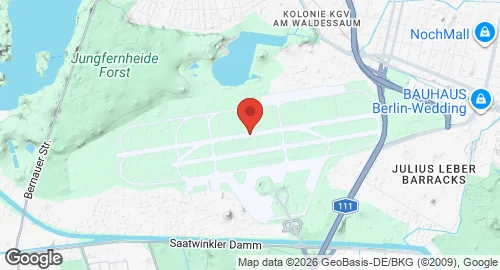
| Coordinates | 52.5597°N, 13.2878°E |
| Elevation | 37 m (121 ft) |
| IATA code | TXL |
| ICAO code | EDDT |
| Runways |
|
Description
Berlin Tegel Airport is located in the Reinickendorf borough, eight kilometers northwest of central Berlin. Originally a Prussian artillery range, the site hosted the Royal Prussian Airship battalion in the early 20th century. In August 1914, it became a training facility for aerial reconnaissance crews. During the 1930s, the site housed a rocket research facility under Rudolf Nebel and Wernher von Braun before serving as a training area for Flak troops in World War II.
The airfield was established in 1948 by French military authorities to support the Berlin Airlift. Construction began on August 5, 1948, and the first landing, a United States Air Force Douglas C-54 Skymaster, occurred on November 5, 1948. British Dakota and Hastings aircraft subsequently conducted regular cargo missions. On August 1, 1964, the site was designated Base aérienne 165 for the French Air Force. Military units stationed there included a detachment of French Army Light Aviation, which operated Cessna O-1 Bird Dog aircraft and Sud-Ouest Alouette III helicopters. The French Air Force also operated Max Holste MH1521 Broussard and DeHavilland Canada DHC-6-300 Twin Otter aircraft for liaison and surveillance until its deactivation in 1994.
The facility is decommissioned. Passenger services ended on November 8, 2020, and the airfield was legally closed on May 4, 2021. The minor military area, Tegel Nord, was used for government helicopter flights until October 2025. Current redevelopment plans involve converting the grounds into the Urban Tech Republic for scientific and industrial research.
Infrastructure consisted of five terminal areas, including a hexagonal ring concourse (Terminal A) and a converted car park (Terminal D). Since its closure, the terminal building has served as a COVID-19 vaccination center. In March 2022, the site was converted into temporary housing for refugees fleeing Ukraine. As of June 2024, the facility sheltered approximately 5,000 individuals.