MCAS Futenma
Summary
| Operating Country | 🇯🇵 Japan |
| Location | 🇯🇵 Japan |
| Status | ◉ Active |
| Usage | Military only |
| Year built | 1945 |
| Operating Organization | US Marine Corps |
| Units |
|
Location & Details
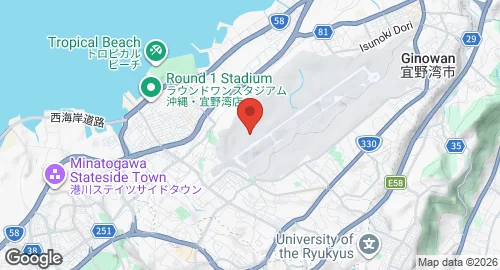
| Coordinates | 26.2708°N, 127.7481°E |
| Elevation | 76 m (249 ft) |
| ICAO code | ROTM |
| Runways |
|
Description
Marine Corps Air Station (MCAS) Futenma is a United States Marine Corps facility located in Ginowan, Okinawa, Japan. The airfield was established in 1945 following the Battle of Okinawa and was originally intended for Eighth Air Force B-29 Superfortress operations. During the post-war period, it functioned as a United States Air Force installation supporting Kadena Air Base and hosting fighter-interceptor squadrons. The facility was transferred to the United States Navy in June 1957 and subsequently developed into a Marine Corps air station by U.S. Navy Mobile Construction Battalions 2 and 3.
The base is operated by the U.S. Marine Corps under the 1st Marine Aircraft Wing and is part of the Marine Corps Installations Pacific command. It houses approximately 3,000 Marines and is used for training and providing air support to land and sea-based Marine units in the Asia-Pacific region. The installation supports the III Marine Expeditionary Force and serves as a United Nations air distribution hub for disaster and crisis response.
The station hosts multiple flying and support units. Marine Aircraft Group 36 operates squadrons of MV-22B Osprey tilt-rotor aircraft, including VMM-262 and VMM-265. The Headquarters and Headquarters Squadron operates UC-12W Huron and UC-35D Encore aircraft. Other resident units include Marine Air Control Group 18, Marine Aviation Logistics Squadron 36, and Marine Wing Support Squadron 172. Infrastructure includes administrative and logistical facilities and barracks.
Recent developments at the station involve ongoing negotiations regarding its relocation. Plans to move operations to Camp Schwab in Henoko have faced delays due to local political opposition and environmental concerns. In June 2013, base officials and Ginowan City signed a bilateral agreement establishing procedures for civilian evacuation through the air station during natural disasters. Environmental monitoring has also addressed concerns regarding groundwater and soil quality in areas surrounding the installation.