NATO Air Base Geilenkirchen
Summary
| Operating Country | 🇺🇸 United States |
| Location | 🇩🇪 Germany |
| Status | ◉ Active |
| Usage | Military only |
| Year built | 1953 |
| Operating Organization | US Air Force |
| Units |
|
Location & Details
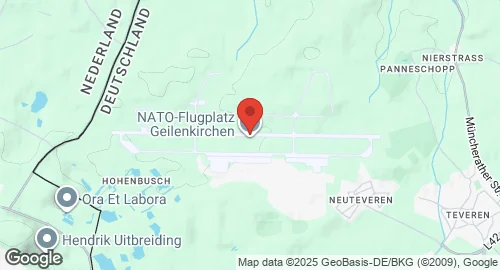
| Coordinates | 50.9608°N, 6.0425°E |
| Elevation | 89 m (292 ft) |
| IATA code | GKE |
| ICAO code | ETNG |
| Runways |
|
Description
NATO Air Base Geilenkirchen is situated near the village of Teveren in North Rhine-Westphalia, Germany, six kilometers west of Geilenkirchen. The 620-hectare installation lies adjacent to the German-Dutch border. Built by the British Royal Air Force (RAF) in 1953, the facility functioned as RAF Geilenkirchen until 1968, hosting multiple fighter squadrons. In 1968, the installation transferred to the German Air Force and became the station for Missile Wing 2, which operated Pershing 1A missiles supported by the U.S. Army 85th Field Artillery Detachment.
In 1980, NATO selected the base as the Main Operating Base (MOB) for its Airborne Early Warning and Control Force E-3A Component. Major construction to modify facilities began that year, and the first E-3A personnel arrived in January 1980. The base was formally handed over to NATO on March 31, 1982. The E-3A Component reached full operational capability in 1988.
The base is currently controlled by the Supreme Allied Commander Europe (SACEUR) and serves as the primary station for the E-3A Component. This multinational unit consists of more than 2,500 military and civilian personnel organized into Operations, Logistics, and Base Support wings. Command of the component alternates between German and United States officers of brigadier general rank. The base operates a fleet of Boeing E-3A Sentry aircraft, which are registered in Luxembourg. While Geilenkirchen is the central hub, the component also utilizes forward operating bases in Greece, Italy, and Turkey, and a forward operating location in Norway.
Infrastructure includes aprons, taxiways, a control tower, and four renovated hangars. The base houses an information technology wing containing flight and mission simulators. Recent developments include the 2018 completion of the Mid-term Modernization Programme, which upgraded aircraft navigation, digital communications, and workstations. The fleet is currently undergoing the Final Lifetime Extension programme for its mission systems. Flight operations have resulted in noise pollution disputes with the neighboring Dutch region of Parkstad Limburg, involving local NGO activity and Dutch parliamentary motions regarding airspace restrictions.