Cessna Cessna 340
Summary
| Category | Military Transport Aircraft |
| Origin country | 🇺🇸 United States |
| Manufacturer | Cessna |
| First flight | 1 January 1970 |
| Year introduced | 1972 |
| Number produced | 1351 units |
| Average unit price | $0.1 million |
Technical specifications
| Version: 340 | |
|---|---|
| Crew | 1 pilot + 5 passengers |
| Operational range | 2,602 km (1,617 mi) |
| Maximum speed | 452 km/h (281 mph) |
| Wing area | 17.1 m² (184.1 sqft) |
| Wingspan | 11.6 m (38.1 ft) |
| Height | 3.8 m (12.6 ft) |
| Length | 10.5 m (34.3 ft) |
| Service ceiling | 9,100 m (29,856 ft) |
| Empty weight | 1,779 kg (3,922 lbs) |
| Max. takeoff weight | 2,717 kg (5,990 lbs) |
| Climb rate | 8.4 m/s (27.6 ft/s) |
| Powerplant | 2 x Continental TSIO-520-NB engines delivering 230 kW each |
Current operating countries
| Country | Units | ||
|---|---|---|---|

|
Bolivia | 1 | |
All operators
Description
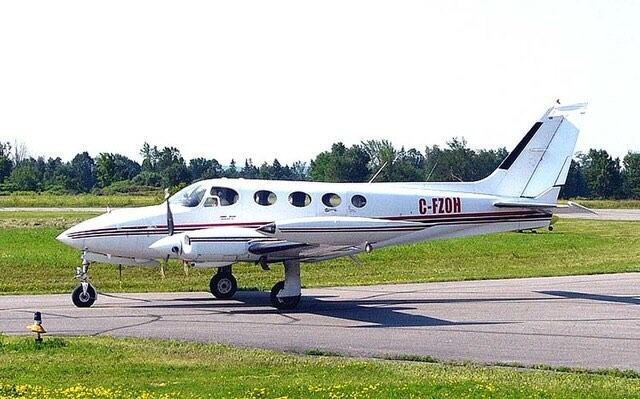
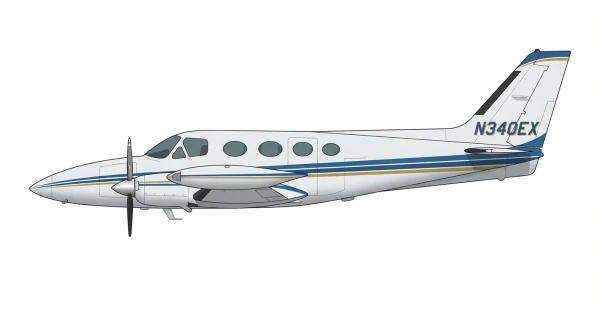
The Cessna 340 was conceived as a cabin-class development of the Cessna 310. It is a six-seat aircraft, configured with four passenger seats, an aisle, and an airstair door. Its tail and landing gear were derived from the Cessna 310, while its wings were taken from the Cessna 414. A key feature was its spacious, pressurized cabin, a first for a light twin aircraft. Development began in 1969, with the first aircraft delivered in 1971, a delay caused by a prototype crash during flight testing in 1970.
Early models were equipped with two turbocharged Continental TSIO-520-K engines, each producing 285 hp (214 kW). In 1976, the engines were upgraded to the more powerful Continental TSIO-520-NB engines of 310 hp (233 kW), leading to the 340A variant which also featured smaller 75.5-inch (1,920 mm) diameter propellers to meet ICAO Annex 16 noise requirements.
The Cessna 335, an unpressurized version powered by 300 hp (225 kW) Continental TSIO-520-EB engines, had its first flight on December 5, 1978, with the first production aircraft following in 1979. Production of the 340 continued until 1984 with 1287 built, while only 64 of the 335 were built before production ended in 1980.
Main Variants:
-
340: The initial version of the aircraft, this pressurized six-seat twin is powered by two Continental TSIO-520-K engines, each producing 285 hp (213 kW).
-
340A: An upgraded variant featuring enhanced performance, it is powered by two Continental TSIO-520-NB engines, each generating 310 hp (230 kW).
-
335: This is a non-pressurized version of the Cessna 340, accommodating six seats and powered by two Continental TSIO-520-EB engines, each rated at 300 hp (220 kW).
-
Riley Rocket 340: A modified Cessna 340, this conversion involves the installation of two 340 hp (250 kW) Lycoming TIO-540-R engines.
-
Riley Super 340: This is a conversion of the 1972–1975 Cessna 340 models, achieved by incorporating two 310 hp (230 kW) Continental TSIO-520-J/-N engines.