Australia vs United Kingdom
AI Analysis
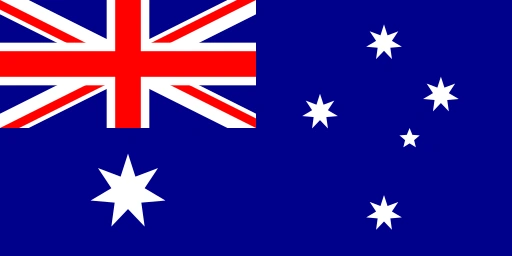
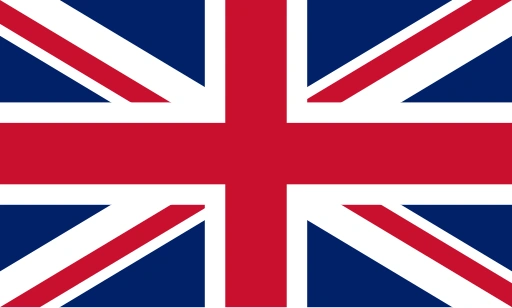
The relationship between the flags of Australia and the United Kingdom is one of direct lineage, as the Australian design incorporates the UK's Union Flag as its primary component. This inclusion classifies the Australian flag as a British Blue Ensign, a standard colonial pattern that visually subordinates local symbols to the imperial emblem. Consequently, the Union Flag exists both as an independent national symbol and as a constituent element of the Australian national identity.
Design Comparison
Both flags employ the same red, white, and blue color palette and adhere to a 1:2 aspect ratio. The United Kingdom's design—commonly known as the Union Jack—is a composite of three heraldic crosses: the central vertical red cross of Saint George, the white diagonal saltire of Saint Andrew, and the red diagonal saltire of Saint Patrick. The Australian flag utilizes the Union Jack in the canton (upper hoist quarter). The remainder of the design consists of a blue field defaced with six white stars: the large seven-pointed Commonwealth Star directly beneath the canton and the Southern Cross constellation arranged in the fly.
Historical Context
The Union Flag attained its current form in 1801 following the Act of Union between Great Britain and Ireland, adding Saint Patrick's saltire to the 1606 design commissioned by King James I. This evolution reflected the political unification of the British Isles. Conversely, the Australian flag originated in 1901 via a government design competition following the federation of the Australian colonies. The winning design adhered to British Admiralty rules requiring the use of an ensign, symbolizing Australia's constitutional ties to the United Kingdom. While the Union Flag commemorates a union of crowns, the Australian flag commemorates a federation of states within the British Empire.
How to Tell Them Apart
Distinguishing these flags is straightforward if one looks beyond the top-left corner:
-
United Kingdom: The design is comprised entirely of intersecting vertical and diagonal crosses that stretch to the edges of the flag. There are no stars or open fields of solid color.
-
Australia: The Union Jack is restricted to the upper left quadrant. The majority of the flag is a solid blue field containing white stars of varying sizes.
Conclusion
The fundamental difference lies in heraldic hierarchy. The United Kingdom's flag serves as the parent design, representing the sovereign unification of England, Scotland, and Ireland. The Australian flag serves as a derivative ensign, blending the imperial heritage of the Union Jack with celestial symbols unique to the Southern Hemisphere to denote a distinct, yet historically connected, national entity.