Ireland vs Ivory Coast
AI Analysis
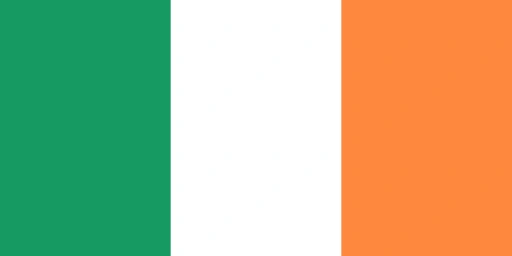
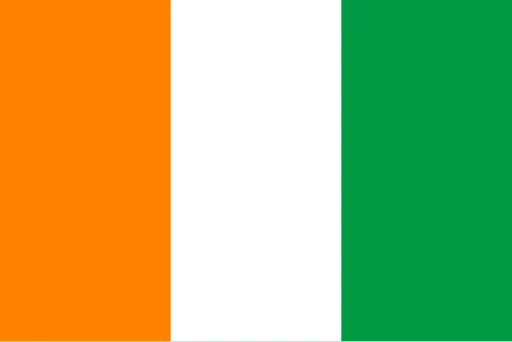
The national flags of Ireland and Ivory Coast (Côte d'Ivoire) are frequently confused due to their identical tricolor composition and shared color palette. Both nations utilize vertical bands of green, white, and orange, appearing as mirror images of one another. Despite this visual convergence, their designs emerged from unrelated historical contexts on different continents, representing distinct cultural narratives—one rooted in European sectarian reconciliation and the other in West African geography and post-colonial identity.
Design Comparison
Both flags feature a vertical tricolor design comprising three equal bands. The primary visual distinction lies in the ordering of the colors relative to the hoist (the side attached to the flagpole):
-
Ireland: The bands are arranged green, white, and orange.
-
Ivory Coast: The bands are arranged orange, white, and green.
Beyond the color sequence, the physical dimensions differ. The Irish flag utilizes a 1:2 aspect ratio, creating an elongated rectangular shape commonly seen in flags of the British Commonwealth. In contrast, the Ivorian flag employs a 2:3 aspect ratio, resulting in shorter, squarer proportions standard to French and international vexillology.
Historical Context
The structural similarity between these flags stems from a shared inspiration: the French Tricolour. Thomas Francis Meagher introduced the Irish design in 1848, modeled after the French revolutionary symbol. The colors were selected to represent a political desire for peace: green for the Gaelic Catholic tradition, orange for the Williamite Protestant minority, and white for a lasting truce between them. It was officially adopted by the Irish Republic in 1919 and confirmed by the constitution in 1937.
Ivory Coast adopted its flag on December 3, 1959, prior to independence from France. While retaining the vertical French layout, the colors were chosen to reflect national geography rather than religious factions. The orange represents the northern savannas and national growth, the white symbolizes peace, and the green denotes the southern coastal forests and hope.
How to Tell Them Apart
Distinguishing these flags requires attention to the position of the colors and the shape of the banner:
-
Check the Hoist: Look at the stripe touching the flagpole. If it is green, it is Ireland. If it is orange, it is Ivory Coast.
-
Geographic Mnemonic: Associate the "Emerald Isle" (Ireland) with the green stripe leading the design.
-
Aspect Ratio: If the flag appears significantly longer than it is tall (1:2), it is Irish. A more compact rectangular shape (2:3) indicates Ivory Coast.
Conclusion
While the flags of Ireland and Ivory Coast share a palette and the vertical tricolor format, they are distinct national symbols. Ireland's banner serves as a political emblem of religious unity, oriented with green at the hoist, whereas Ivory Coast's ensign acts as a geographical representation of the land, oriented with orange at the hoist.