Norway vs Iceland
AI Analysis
The national flags of Norway and Iceland serve as prime examples of the shared vexillological heritage found across Scandinavia. Both banners feature the Nordic Cross—an asymmetrical cross design shifted toward the hoist—and utilize an identical palette of red, white, and blue. These similarities reflect centuries of interconnected political history and the pervasive influence of the Danish Dannebrog on the region's symbolism, often leading to confusion for observers unfamiliar with the specific color arrangements.
Design Comparison
While structurally identical in their use of the fimbriated Nordic Cross, the flags employ distinct color arrangements and dimensional specifications.
-
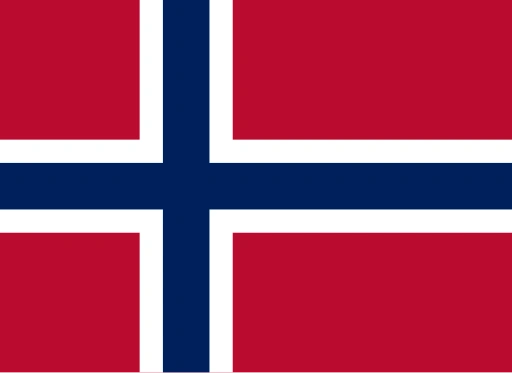
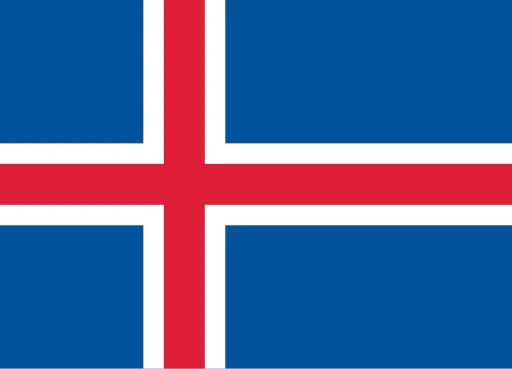
Color Distribution: The Flag of Norway presents a red field charged with a blue cross outlined in white. In contrast, the Flag of Iceland features a sky-blue field with a red cross bordered in white. Essentially, the primary background and cross colors are inverted.
-
Symbolism: Norway's colors represent the liberal ideals of the French and American revolutions, alongside historical ties to Denmark (red/white) and Sweden (blue). Iceland's palette directly references its geology: red for volcanic fire, white for glacial snow, and blue for the ocean and sky.
-
Dimensions: The flags utilize different aspect ratios, with Norway set at 8:11 and Iceland officially distinct at 18:25.
Historical Context
The Flag of Norway was designed in 1821 by parliamentarian Fredrik Meltzer. Seeking to replace the Danish flag following the dissolution of the Denmark-Norway union, Meltzer combined the traditional red and white of Denmark with the blue of Sweden to create a distinct national identity while acknowledging regional ties.
The Flag of Iceland originated later, evolving from an unofficial banner known as the Hvítbláinn (a blue flag with a white cross). Because the Hvítbláinn closely resembled the Greek flag, a red cross was inserted inside the white one. This design was adopted for official use in 1915 and ratified as the national flag upon the founding of the Republic of Iceland in 1944, cementing the nation's independence from Danish rule.
How to Tell Them Apart
-
Check the Background: If the primary field is red, it is Norway. If the primary field is blue, it is Iceland.
-
Check the Cross: Norway features a blue cross; Iceland features a red cross.
Conclusion
Despite sharing the Nordic Cross geometry and a red-white-blue tri-color scheme, the flags of Norway and Iceland are distinguished by their primary field colors. Norway utilizes a red background rooted in political alliances and history, while Iceland employs a blue background symbolizing its distinct natural environment.