Bahrain Military Forces
Open-source order of battle for 2026: 8,200 active troops, 136 aircraft, 65 warships, 1,278 ground vehicles.
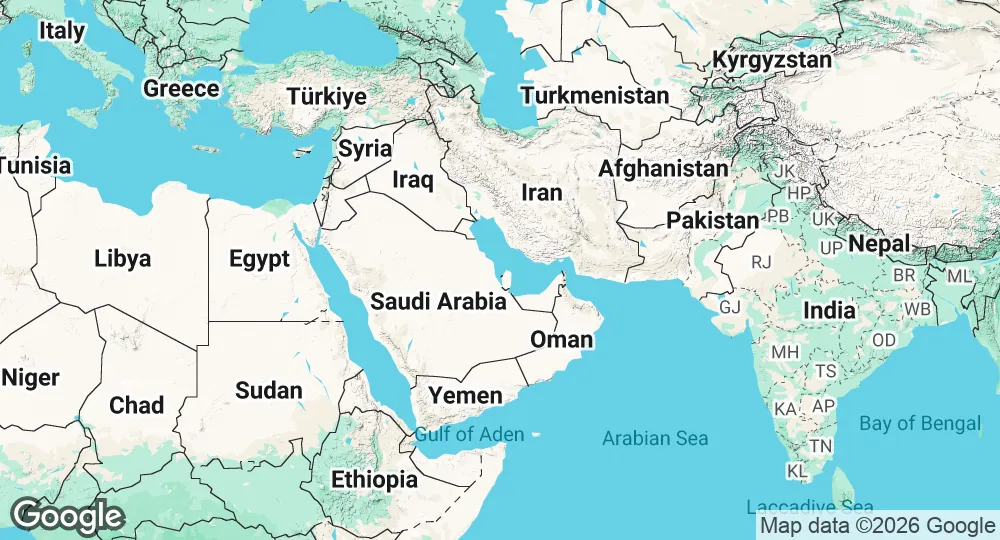

Armed Forces in 2026
| Domain | Strength | Composition |
|---|---|---|
| Royal Bahraini Air Force | 136 aircraft | 44 combat 80 helicopters 4 air bases +3 on order |
| Royal Bahrain Naval Force | 65 warships | 2 major combatants |
| Ground Forces | 1,278 vehicles | 150 main battle tanks |
| Personnel | 8,200 active | 11,260 paramilitary |
ARMS Index (Aggregate Rating of Military Strength)
Full ranking →| Pillar | Weight | Score | Basis |
|---|---|---|---|
| Manpower | 15% | 47.3 | Active, reserve & paramilitary personnel |
| Ground forces | 20% | 50.1 | Tanks, armor & artillery weighted by type |
| Naval power | 20% | 29.4 | Weighted by hull type: carrier tiers, nuclear vs conventional submarines |
| Air power | 25% | 41.2 | Weighted by aircraft type and fleet age |
| Nuclear deterrent | 10% | 0.0 | No declared nuclear capability |
| Defense budget | 10% | 36.0 | Annual spending, purchasing-power adjusted |
| Readiness | modifier | ×1.10 | Budget per soldier: proxy for training, maintenance & technology |
Country File
| Population | 1.6M (2024) |
| GDP | $47.1 billion (2024) |
| GDP per capita | $29,654 |
| Military budget | $1.4B (2024) |
| Share of GDP | 3.0% (2024) |
| Military spending per capita | $890 (2024) |
| Inflation rate | 0.92% (2024) |
| Capital | Manama |
| Region | Asia |
| Land area | 786 km² |
| Coastline | 161 km |
| Bordering countries | 1 |
| Currency | BHD |
Strategic Overview in 2026
Strategic Position
Bahrain occupies a geostrategic position in the central Persian Gulf, situated between the Qatar Peninsula and the eastern coast of Saudi Arabia. Its security doctrine is predicated on its proximity to Iran and the requirement to maintain open maritime transit through the Strait of Hormuz.
The kingdom maintains a deep security architecture with Western powers. It serves as a Major Non-NATO Ally of the United States and hosts the headquarters of the U.S. Naval Forces Central Command (NAVCENT) and the U.S. 5th Fleet at Naval Support Activity Bahrain. Additionally, the United Kingdom maintains a permanent naval presence at HMS Juffair. These bilateral arrangements provide a security umbrella that supplements Bahrain’s national capabilities.
Regional integration is facilitated through the Gulf Cooperation Council (GCC) and its Peninsula Shield Force. Bahrain is also a signatory to the Comprehensive Security Integration and Prosperity Agreement (C-SIPA), which formalizes security and economic cooperation with the United States. Following the 2020 Abraham Accords, Bahrain has established security ties with Israel, focusing on maritime domain awareness and integrated air and missile defense.
Military Forces
The Bahrain Defence Force (BDF) is the primary military organization, under the command of the King as Supreme Commander. The BDF maintains an active strength of approximately 8,000 to 10,000 personnel, supplemented by the National Guard and the Ministry of Interior’s paramilitary forces.
Royal Bahraini Army (RBA) The army is organized into several brigades, including armored, mechanized, and infantry formations. Primary land systems consist of M60A3 main battle tanks. Armored transport is provided by M113 variants and YPR-765 armored personnel carriers. Artillery support includes M109 self-propelled howitzers and Multiple Launch Rocket Systems (MLRS).
Royal Bahraini Air Force (RBAF) The RBAF provides air defense and close air support. Fixed-wing combat capabilities center on the F-16 Fighting Falcon, including the Block 70 (Viper) variant, and the F-5 Tiger II. The rotary-wing fleet includes AH-1 Cobra attack helicopters, utilized for maritime interdiction and anti-armor roles, alongside UH-60 Black Hawk and Bell 212 transport helicopters.
Royal Bahraini Naval Force (RBNF) The RBNF focuses on coastal defense and patrol operations within the Gulf. The fleet's flagship is the frigate RBNS Sabha. Additional assets include corvettes, such as the Al-Manama class, and a variety of fast attack craft equipped with anti-ship missiles. In 2025, the navy continued its integration into the Combined Maritime Forces (CMF), a multi-national partnership focused on counter-piracy and counter-terrorism.
Royal Guard The Royal Guard is an elite unit separate from the standard BDF chain of command, tasked with the protection of the monarchy and specialized combat operations. It maintains its own reconnaissance and special forces elements and has been utilized in regional expeditionary operations.
Strategic Trends
Defense policy in 2025 and 2026 emphasizes the modernization of technical assets over the expansion of personnel. A primary procurement priority is the integration of F-16 Block 70 aircraft, which introduces advanced AESA radar capabilities to the RBAF.
The defense budget typically ranges between 3.5% and 4.5% of GDP. Spending is increasingly directed toward unmanned systems and electronic warfare. The BDF is expanding its use of unmanned surface vessels (USVs) and unmanned aerial vehicles (UAVs) to monitor territorial waters, responding to the proliferation of asymmetric threats in the Red Sea and Persian Gulf.
A key doctrinal shift involves transitioning toward a multi-layered integrated air and missile defense (IAMD) network. This effort involves synchronizing Bahrain’s existing Patriot missile batteries with regional partners to counter ballistic missile and loitering munition threats. Constraints facing the military include a heavy reliance on foreign contractors for technical maintenance and the geographic challenge of defending a small island territory against sophisticated regional adversaries.
Military Expenditure: CIA World Factbook. Last updated on 11 August 2026. Suggest a change
Frequently Asked Questions
How large is Bahrain's military?
What is Bahrain's defense budget?
How does Bahrain rank militarily in the world?
Does Bahrain have nuclear weapons?
How many aircraft does Bahrain's air force have?
How large is Bahrain's navy?
How many tanks does Bahrain have?
What percentage of GDP does Bahrain spend on defense?
What is Bahrain's military personnel per capita?
Does Bahrain have paramilitary forces?
- AUG 112026 Updated Global Military Index updated
- AUG 102026 Updated Rank insignia and ranks overview added
- AUG 42026 Updated Global Military Index updated in a site-wide editorial pass
- AUG 32026 Updated Global Military Index updated
- JUL 162026 Updated Global Military Index updated in a site-wide editorial pass
- JUN 162026 Updated Yearly statistics, military spending and 2 more fields updated
- JAN 172026 Updated Main battle tank count and Global Military Index updated