Congo Democratic Republic Military Forces
The Congo Democratic Republic ranks #88 of 170 militaries worldwide in 2026, with 134,250 active troops. The Congo Democratic Republic Army fields 105 main battle tanks; the Air Force flies 57 aircraft, including 6 combat aircraft. The Congo Democratic Republic has no nuclear weapons.
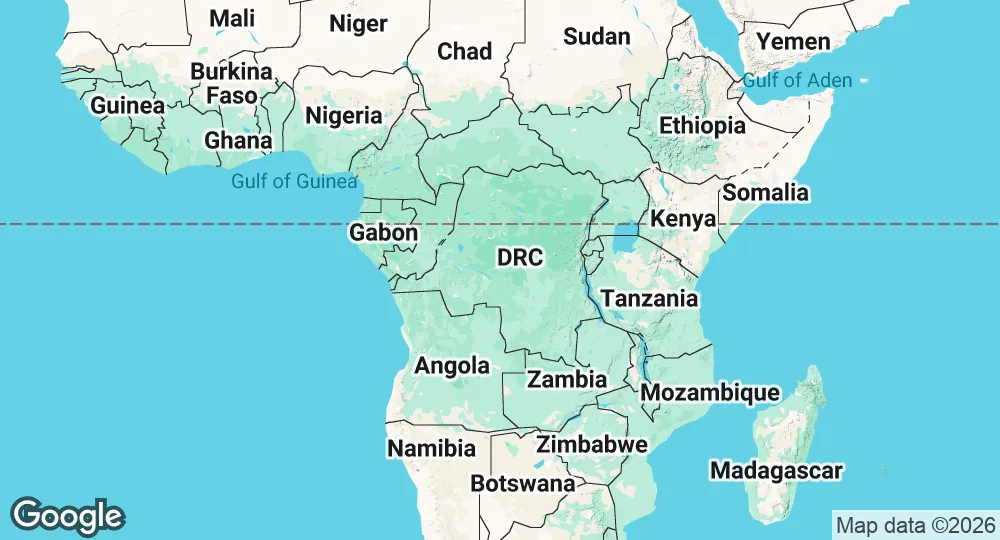
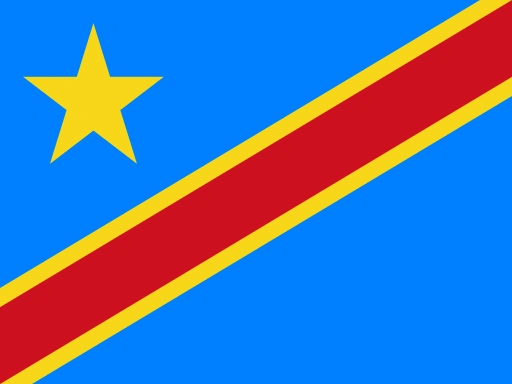
Armed Forces in 2026
| Domain | Strength | Composition |
|---|---|---|
| Air Force of the Democratic Republic of the Congo | 57 aircraft | 6 combat 38 helicopters +1 on order |
| Ground Forces | 105 tanks | |
| Personnel | 134,250 active |
ATLAS Index (Aggregate Total of Land, Air and Sea strength)
Full ranking →| Pillar | Weight | Score | Basis |
|---|---|---|---|
| Manpower | 10% | 43.0 | Active, reserve & paramilitary personnel |
| Ground forces | 20% | 29.0 | ARMS inventory power: armour & artillery by type and era, attack helicopters, armament |
| Naval power | 20% | 0.0 | SEAS inventory power: hulls by type, size and era, air wing, sustainment, armament |
| Air power | 25% | 18.3 | AIRS inventory power: aircraft by type and generation, enablers, armament |
| Nuclear deterrent | 10% | 0.0 | No declared nuclear capability |
| Defense budget | 15% | 17.4 | Annual spending, purchasing-power adjusted |
| Availability | modifier | ground ×0.80 · naval ×1.00 · air ×0.97 | Budget per point of each force, from the branch indexes |
Country File
| Population | 109.3M (2024) |
| GDP | $71.0 billion (2024) |
| GDP per capita | $649 |
| Military budget | $852M (2024) |
| Share of GDP | 1.2% (2024) |
| Military spending per capita | $8 (2024) |
| Inflation rate | 2.89% (2016) |
| Capital | Kinshasa |
| Region | Africa |
| Land area | 2,267,048 km² |
| Coastline | 177 km |
| Land borders | 10,730 km |
| Bordering countries | 9 |
| Currency | CDF |
| Aspect ratio | 3:4 |
| Colors | Red, blue, yellow |
Strategic Overview in 2026
Strategic Position
The Democratic Republic of the Congo (DRC) maintains a defense posture centered on internal security and the preservation of territorial integrity against non-state armed groups in its eastern provinces. The primary security concern remains the conflict in North Kivu, South Kivu, and Ituri provinces, characterized by the activities of the March 23 Movement (M23), which operates as part of the Congo River Alliance (AFC), and the Allied Democratic Forces (ADF).
Key regional dynamics are defined by a adversarial relationship with Rwanda. The Congolese government continues to accuse Rwanda of providing direct military support to M23, a claim corroborated by United Nations reporting that identified thousands of Rwandan Defense Force (RDF) personnel operating on Congolese soil during the 2025 Goma and Bukavu offensives. In December 2025, the Washington Accords were signed under United States mediation to facilitate a cessation of hostilities, though enforcement remains inconsistent as of early 2026.
The DRC has increasingly sought regional and bilateral security arrangements to offset the scheduled withdrawal of international missions. The Southern African Development Community (SADC) Mission in the DRC (SAMIDRC) completed its phased withdrawal in early 2026, following the termination of its mandate by regional heads of state. This departure, alongside the ongoing drawdown of the United Nations Organization Stabilization Mission in the Democratic Republic of the Congo (MONUSCO), has shifted the defensive burden onto the national military and bilateral partners. Notable ongoing cooperation includes Operation Shujaa, a joint offensive with the Uganda People's Defence Forces (UPDF) targeting ADF positions.
Military Forces
The Armed Forces of the Democratic Republic of the Congo (FARDC) are organized into the Land Forces, Navy, and Air Force, supplemented by an elite Republican Guard and specialized units. Total personnel is approximately 165,000 active-duty members, with an additional 30,000 in reserves and 15,000 in paramilitary roles.
The Land Forces represent the largest branch and utilize a diverse inventory of Soviet and Chinese origin. The army operates main battle tanks, including T-72, T-64, and T-55 variants, as well as Type 59 tanks. Mechanized units utilize BATT UMG armored vehicles and older Soviet-era BTR and BMP personnel carriers. Artillery capabilities include D-30 howitzers and the Bastion multiple rocket launcher system.
The Air Force operates a small fleet focused on ground attack and transport. Its combat capability relies on Su-25 Frogfoot attack aircraft and Mi-24/35 Hind attack helicopters. In 2025 and 2026, the military increased its utilization of unmanned aerial vehicles (UAVs) for reconnaissance and strike missions, including CH-4 and Belarusian-origin Berkut systems.
The Navy primarily functions as a littoral and riverine force, operating patrol boats on the Congo River and Lake Tanganyika. The Republican Guard is a separate command reporting directly to the presidency, tasked with protecting the executive and strategic infrastructure, often deploying as a frontline shock force.
A significant development in the force structure is the formalization of the Reserve Armée de la Défense (RAD). This entity integrates various "Wazalendo" (patriot) militias into a state-sanctioned paramilitary reserve to bolster defense in conflict zones where formal FARDC presence is limited.
Defense Industry
The DRC possesses a limited domestic defense industry, largely focused on maintenance and the production of small arms ammunition. The primary state-run entity is Africaine d'Explosifs (Afridex), headquartered in Likasi. In 2025, the government prioritized the expansion of this sector through the construction of the Defense Industrial Complex (CID). This facility is intended to reduce reliance on foreign imports by localizing the manufacture of munitions and basic military hardware. Despite these efforts, the military remains heavily dependent on imports and technical support from China, Russia, Turkey, and South Africa.
Strategic Trends
The Congolese defense posture is undergoing a rapid transition characterized by significant fiscal expansion. The 2026 national budget allocates 30% of total government spending—approximately $6 billion—to the defense and security sectors. This represents a substantial increase from 2025, aimed at funding the 2024–2028 Government Action Program.
Primary procurement and modernization priorities include:
-
The rehabilitation and expansion of military infrastructure, specifically barracks and logistics hubs.
-
The professionalization of the officer corps through new curricula at the Higher School of Military Administration in Kinshasa.
-
Integration of advanced surveillance and strike technology, specifically kamikaze drones and medium-altitude long-endurance (MALE) UAVs.
-
The improvement of soldier welfare and pay systems to reduce desertion and recruitment into rival non-state groups.
Operational constraints include a complex chain of command, logistical difficulties in the country's dense terrain, and the challenge of integrating disparate militia groups into the formal reserve structure without compromising military discipline or human rights standards.
Military Expenditure: CIA World Factbook. Last updated on 4 August 2026. Suggest a change
Frequently Asked Questions
How large is Congo Democratic Republic's military?
What is Congo Democratic Republic's defense budget?
How does Congo Democratic Republic rank militarily in the world?
Does Congo Democratic Republic have nuclear weapons?
How many aircraft does Congo Democratic Republic's air force have?
How many tanks does Congo Democratic Republic have?
What percentage of GDP does Congo Democratic Republic spend on defense?
What is Congo Democratic Republic's military personnel per capita?
- AUG 42026 Updated Global Military Index updated in a site-wide editorial pass
- AUG 32026 Updated Global Military Index updated
- JUL 162026 Updated Global Military Index updated in a site-wide editorial pass
- JUN 162026 Updated Yearly statistics, military spending and 2 more fields updated
- JAN 172026 Updated Main battle tank count and Global Military Index updated
- JAN 132026 Updated Description updated