Micronesia Military Forces 🇫🇲
Military Strength Overview
Geography
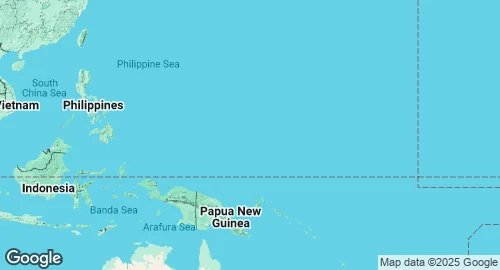
| Capital | Palikir |
| Land Area | 702 km² |
| Coastline Length | 6,112 km |
National Flag

Defense Statistics & Key Metrics
| Population | 112114 (2022) |
| GDP | $430.0 million (2022) |
| GDP per capita | $3835 (2022) |
| Inflation Rate | 5.41% (2022) |
Population and Military Personnel Trends
GDP and Inflation Rate Trends
Strategic Overview in 2026
Strategic Position
The Federated States of Micronesia (FSM) maintains its security posture through the Compact of Free Association (COFA) with the United States. Under this bilateral agreement, the United States holds full authority and responsibility for the defense of the FSM. This includes the "defense veto" power, which allows the United States to deny access to FSM territory or waterways by any third-party military force. In return, the FSM provides the United States with exclusive military access to its land, water, and airspace.
The primary security concerns for the FSM involve maritime domain awareness and the protection of its Exclusive Economic Zone (EEZ). The nation focuses on combating illegal, unreported, and unregulated (IUU) fishing, transnational organized crime, and the security implications of climate change, such as sea-level rise and extreme weather events.
Regionally, the FSM is a member of the Pacific Islands Forum and participates in the Pacific Quadrilateral Defense Coordination Group alongside Australia, France, New Zealand, and the United States. While the FSM maintains diplomatic relations with various international actors, its defense policy is tied to U.S. Indo-Pacific strategy. The current security environment is characterized by increased competition for influence in the Central Pacific, reinforcing the FSM’s reliance on the COFA framework for territorial integrity.
Military Forces
The FSM does not maintain a standing national military. Defense functions are outsourced to the United States Armed Forces, while domestic security and maritime law enforcement are the responsibility of the FSM National Police under the Department of Justice.
National Police and Maritime Surveillance
The Maritime Surveillance Division (MSD) serves as the paramilitary arm of the National Police. It is tasked with patrolling the nation's EEZ, conducting search and rescue operations, and enforcing fisheries legislation. Personnel numbers for the MSD and the National Police are approximately 150 to 200 officers.
Equipment and Capabilities
The MSD operates a fleet of Guardian-class patrol boats provided by Australia. These vessels are the primary assets for maritime interdiction and surveillance. The Guardian-class ships are equipped with modern navigation and communication suites, designed for long-range patrols across the FSM's dispersed island groups.
The FSM does not operate main battle tanks, fighter aircraft, or heavy naval combatants. Air surveillance and logistics are often supported by the U.S. Coast Guard, U.S. Navy, and the Royal Australian Air Force during joint operations.
U.S. Military Presence and Personnel
While the FSM lacks its own military, its citizens serve in the U.S. Armed Forces at a high rate per capita. Under the COFA, FSM citizens are eligible to enlist in the U.S. Army, Navy, Air Force, and Marine Corps. Additionally, the U.S. military maintains a presence through Civic Action Teams (CAT), which perform infrastructure projects and community service. In 2025 and 2026, there is an increased presence of U.S. military personnel involved in site surveys and the preparation of facilities for periodic rotational use.
Strategic Trends
The current defense posture is defined by the 20-year extension of the COFA agreement, which provides the framework for U.S. defense operations through the 2040s. A primary trend in 2025 and 2026 is the expansion of U.S. military infrastructure within the FSM to support the "Agile Combat Employment" doctrine. This involves upgrading airfields and port facilities, particularly in the states of Yap and Chuuk, to allow for the dispersal of aircraft and personnel in the event of regional conflict.
Modernization of domestic security focuses on enhancing maritime surveillance through integrated technology. The FSM is expanding its use of satellite-based monitoring and automated identification systems (AIS) to track vessels within its waters. These efforts are supported by the Pacific Maritime Security Program, which facilitates information sharing between FSM authorities and regional fusion centers.
The FSM's defense budget is largely integrated into its national police funding, with the majority of capital equipment and training costs covered by foreign military financing and aid from the United States and Australia. In 2026, priorities remain focused on the operational readiness of the patrol boat fleet and the development of cyber security protocols to protect critical telecommunications infrastructure, including undersea fiber-optic cables. Efforts are also underway to standardize training with U.S. and Australian counterparts to ensure interoperability during humanitarian assistance and disaster relief (HADR) missions.
Frequently Asked Questions
Does Micronesia have nuclear weapons?
Military Expenditure: SIPRI Milex. Suggest a change