Gabon Military Forces
Gabon ranks #142 of 170 militaries worldwide in 2026, with 4,700 active troops. The Air Force flies 25 aircraft, including 6 combat aircraft. Gabon has no nuclear weapons.
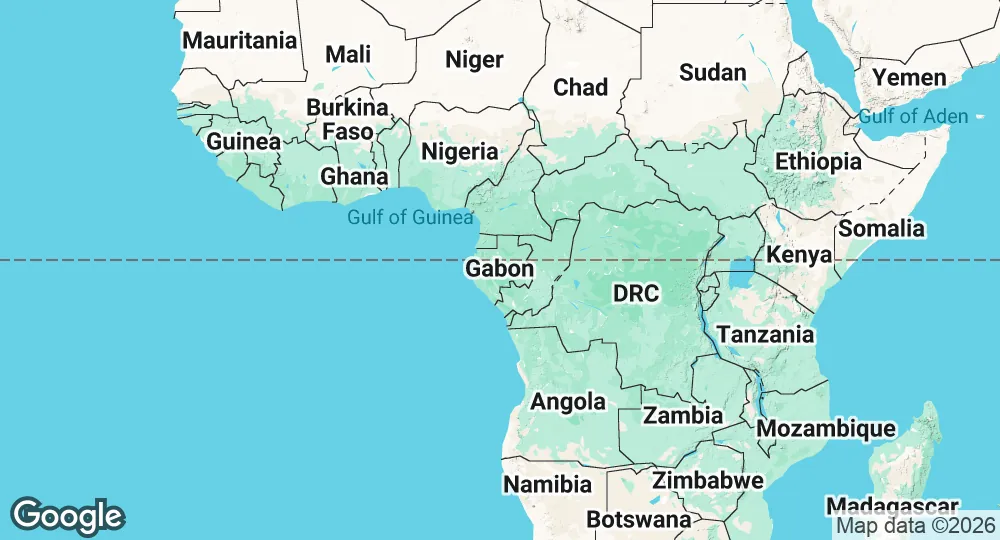

Armed Forces in 2026
| Domain | Strength | Composition |
|---|---|---|
| Air Force | 25 aircraft | 6 combat 16 helicopters |
| Personnel | 4,700 active | 2,000 paramilitary |
ATLAS Index (Aggregate Total of Land, Air and Sea strength)
Full ranking →| Pillar | Weight | Score | Basis |
|---|---|---|---|
| Manpower | 10% | 19.8 | Active, reserve & paramilitary personnel |
| Ground forces | 20% | 0.0 | ARMS inventory power: armour & artillery by type and era, attack helicopters, armament |
| Naval power | 20% | 0.0 | SEAS inventory power: hulls by type, size and era, air wing, sustainment, armament |
| Air power | 25% | 15.4 | AIRS inventory power: aircraft by type and generation, enablers, armament |
| Nuclear deterrent | 10% | 0.0 | No declared nuclear capability |
| Defense budget | 15% | 13.6 | Annual spending, purchasing-power adjusted |
| Availability | modifier | ground ×0.90 · naval ×1.00 · air ×0.91 | Budget per point of each force, from the branch indexes |
Country File
| Population | 2.6M (2025) |
| GDP | $21.4 billion (2025) |
| GDP per capita | $8,263 |
| Military budget | $313M (2024) |
| Share of GDP | 1.5% (2024) |
| Military spending per capita | $121 (2024) |
| Inflation rate | 1.77% (2025) |
| Capital | Libreville |
| Region | Africa |
| Land area | 257,667 km² |
| Coastline | 885 km |
| Land borders | 2,551 km |
| Bordering countries | 3 |
| Currency | XAF |
Strategic Overview in 2026
Strategic Position
Gabon occupies a central position on the Atlantic coast of Central Africa, with its security posture primarily defined by the management of maritime resources and the maintenance of domestic stability following the transition from the Bongo dynasty. The geopolitical context is currently shaped by the Committee for the Transition and Restoration of Institutions (CTRI), which assumed authority after the August 2023 coup. General Brice Oligui Nguema, formerly head of the Republican Guard, was elected president in April 2025, formalizing the military’s central role in the national government.
Primary security concerns involve maritime piracy and illegal, unreported, and unregulated (IUU) fishing in the Gulf of Guinea. Gabon participates in the Yaoundé Architecture, a regional framework for maritime security and information sharing among Gulf of Guinea states. In 2025, the International Court of Justice adjudicated a long-standing maritime boundary dispute with Equatorial Guinea, providing a legal basis for the enforcement of exclusive economic zone (EEZ) claims in hydrocarbon-rich waters.
Defense doctrine emphasizes regime security and territorial integrity through bilateral and regional partnerships. Gabon is a member of the Economic Community of Central African States (ECCAS) and the Council for Peace and Security in Central Africa (COPAX). Relations with France, which were suspended following the 2023 coup, were restored in late 2025. A two-year renewal of the bilateral defense pact was finalized during a French state visit in November 2025, focusing on training and environmental security. Additionally, Gabon maintains security cooperation with the United States and has explored expanded engagement with Russia, China, and Turkey for equipment and technical assistance.
Military Forces
The Gabonese Defense and Security Forces (FDSG) are organized into the Army, Air Force, Navy, and National Gendarmerie. The Republican Guard (GR) functions as an autonomous, elite formation responsible for the security of the presidency and critical infrastructure. Total active personnel across all branches is approximately 7,000.
The Army focuses on infantry and mechanized reconnaissance. Its inventory includes ERC-90 Sagaie and AML-90 armored cars, EE-11 Urutu and EE-9 Cascavel vehicles, and Bastion armored personnel carriers. Artillery support is provided by D-30 122mm howitzers and Teruel multiple rocket launchers.
The Air Force (Armée de l'Air Gabonaise) operates from two primary bases: BA01 in Libreville and BA02 in Franceville. The force maintains a fleet of Mirage F1 fighters, although their operational status varies. Transport capabilities were updated with the delivery of an Airbus C295 in 2023 and the overhaul of existing CN235 aircraft in late 2024. The helicopter fleet includes AS332 Super Puma and SA330 Puma models for utility and transport roles.
The Navy (Marine Nationale) is tasked with coastal defense and EEZ patrolling. It operates P400 class patrol boats and the OPV50-class vessel Admiral Alioune Baba. In 2025, naval operations prioritized patrols near the maritime border with Equatorial Guinea following the resolution of the territorial dispute.
The Republican Guard remains the most equipped and funded unit in the force structure. It possesses its own light armored assets and specialized infantry units. The National Gendarmerie, while under the Ministry of National Defense, maintains a distinct command for rural and border security.
Strategic Trends
Defense spending in Gabon is approximately 1.1% to 1.3% of GDP, with recent budget cycles reflecting a focus on personnel costs and the modernization of the Republican Guard. Procurement priorities include light armored vehicles for internal security and maritime surveillance assets to counter piracy.
A trend toward diversifying defense partners is evident. In October 2025, Gabon hosted the "Competence" initiative in partnership with the Islamic Military Counter Terrorism Coalition (IMCTC), focusing on joint operations and intelligence analysis. While France remains the primary source of training and doctrine, the government has signed multiple cooperation agreements with Turkey and has engaged in security dialogues with Russia and the United States.
Force structure shifts involve the integration of military personnel into civilian administrative roles following the 2025 election. Constraints facing the military include the limited serviceability of older fixed-wing aircraft and a reliance on external technical support for complex maintenance. Future procurement is expected to focus on unmanned aerial vehicles (UAVs) for border monitoring and the acquisition of additional coastal patrol craft.
Military Expenditure: CIA World Factbook. Last updated on 25 September 2026. Suggest a change
Frequently Asked Questions
How large is Gabon's military?
What is Gabon's defense budget?
How does Gabon rank militarily in the world?
Does Gabon have nuclear weapons?
How many aircraft does Gabon's air force have?
What percentage of GDP does Gabon spend on defense?
What is Gabon's military personnel per capita?
Does Gabon have paramilitary forces?
- SEP 252026 Updated Population, GDP and inflation added for 2025
- AUG 42026 Updated Global Military Index updated in a site-wide editorial pass
- AUG 32026 Updated Global Military Index updated
- JUL 162026 Updated Global Military Index updated in a site-wide editorial pass
- JUN 162026 Updated Yearly statistics, military spending and 2 more fields updated
- JAN 132026 Updated Description added