Guyana Military Forces
Guyana ranks #144 of 170 militaries worldwide in 2026, with 3,400 active troops. The Air Force flies 11 aircraft. Guyana has no nuclear weapons.

Armed Forces in 2026
| Domain | Strength | Composition |
|---|---|---|
| Guyana Defence Force Air Command | 11 aircraft | 3 helicopters |
| Personnel | 3,400 active | 670 reserve |
ATLAS Index (Aggregate Total of Land, Air and Sea strength)
Full ranking →| Pillar | Weight | Score | Basis |
|---|---|---|---|
| Manpower | 10% | 18.0 | Active, reserve & paramilitary personnel |
| Ground forces | 20% | 0.0 | ARMS inventory power: armour & artillery by type and era, attack helicopters, armament |
| Naval power | 20% | 0.0 | SEAS inventory power: hulls by type, size and era, air wing, sustainment, armament |
| Air power | 25% | 14.3 | AIRS inventory power: aircraft by type and generation, enablers, armament |
| Nuclear deterrent | 10% | 0.0 | No declared nuclear capability |
| Defense budget | 15% | 12.5 | Annual spending, purchasing-power adjusted |
| Availability | modifier | ground ×0.88 · naval ×1.00 · air ×0.91 | Budget per point of each force, from the branch indexes |
Country File
| Population | 831K (2024) |
| GDP | $24.7 billion (2024) |
| GDP per capita | $29,675 |
| Military budget | $222M (2024) |
| Share of GDP | 0.9% (2024) |
| Military spending per capita | $267 (2024) |
| Inflation rate | 2.9% (2024) |
| Capital | Georgetown |
| Region | America |
| Land area | 196,849 km² |
| Coastline | 459 km |
| Land borders | 2,462 km |
| Bordering countries | 3 |
| Currency | GYD |
Strategic Overview in 2026
Strategic Position
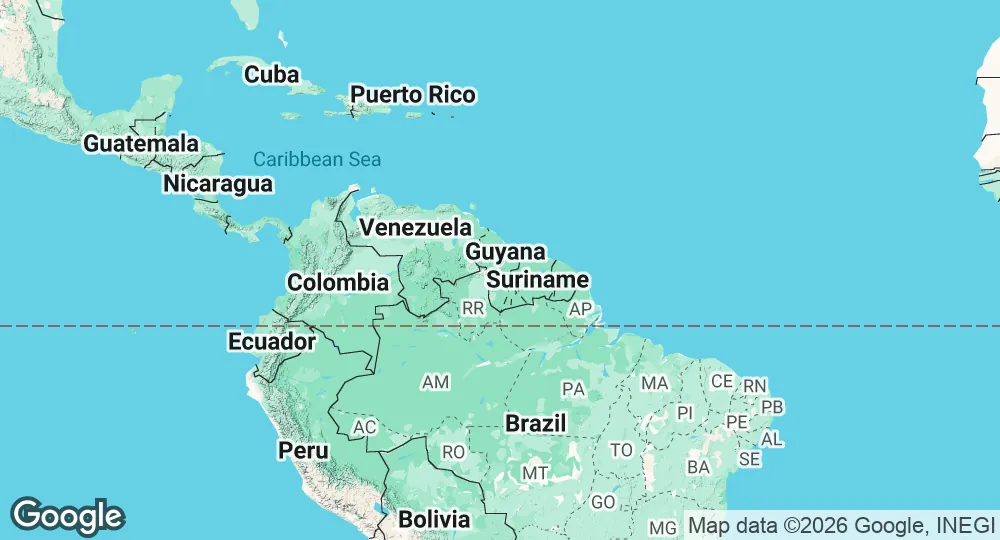
Guyana occupies a central geopolitical position on the northern coast of South America, characterized by a persistent territorial dispute with Venezuela over the Essequibo region. This claim, which encompasses two-thirds of Guyanese territory, remains the primary driver of national defense policy. In early 2026, the regional security landscape underwent a fundamental shift following the political transition in Venezuela, which reduced the immediate threat of conventional military incursion and maritime blockades in the Atlantic Sea. Despite this shift, Guyana maintains a posture of high readiness to safeguard its sovereign borders and hydrocarbon infrastructure.
Guyana is a member of the Caribbean Community (CARICOM) and the Regional Security System (RSS), the latter of which provides a framework for collective defense and regional security cooperation. Bilateral security relationships are the foundation of Guyana’s defense strategy, specifically with the United States, the United Kingdom, Brazil, and France. In late 2025, Guyana signed a Statement of Intent with the United States to integrate into the "Southern Spear" security strategy, an initiative aimed at strengthening Western Hemisphere defense partnerships. Guyana also maintains defense cooperation with India, primarily focused on technical training and hardware procurement.
Military Forces
The Guyana Defence Force (GDF) is a unified military organization under the command of the Chief of Defence Staff. The GDF consists of the Land Forces, Coast Guard, and Air Corps, with a total active and reserve strength of approximately 4,500 personnel. The force is transitionary, moving from a constabulary role toward a conventional defense posture.
Land Forces The Land Forces are organized into infantry battalions, including the 1st and 2nd Infantry Battalion Groups, supported by a specialized 31 Special Forces Squadron. The engineering corps is tasked with both tactical support and national infrastructure development. The GDF operates Brazilian-made EE-9 Cascavel armored reconnaissance vehicles and EE-11 Urutu armored personnel carriers. Artillery assets include D-30 towed howitzers and various mortar systems.
Coast Guard The Coast Guard is responsible for patrolling Guyana's Exclusive Economic Zone (EEZ) and securing offshore oil and gas assets. The fleet is composed primarily of patrol vessels and interceptors. Key assets include the GDFS Shahoud, a 115 Defiant-class offshore patrol vessel, and the GDFS Berbice, a 35-meter patrol boat. The GDF is currently integrating a 58-meter OPV 190 offshore patrol vessel ordered from the French shipbuilder OCEA to enhance long-range maritime surveillance and enforcement.
Air Corps The Air Corps provides transport, surveillance, and medical evacuation capabilities. Fixed-wing assets include Beechcraft Super King Air 350 and HAL-228 (Dornier) aircraft. In 2025, the Air Corps commissioned Italian-built Tecnam P2012 STOL aircraft to facilitate operations in the hinterland and remote border outposts. The rotary-wing fleet consists of Bell 412, Bell 429, and Bell 206 helicopters, which are used for rapid troop deployment and search-and-rescue missions.
Defense Industry
Guyana lacks a domestic arms manufacturing sector and is entirely reliant on foreign imports for military hardware. Procurement is diversified across several primary suppliers, including the United States for maritime and surveillance equipment, India for transport aircraft, and France for offshore patrol vessels. There are ongoing discussions regarding the establishment of domestic maintenance and repair facilities in partnership with foreign shipbuilders, specifically the French firm OCEA, to provide localized sustainment for the growing maritime fleet.
Strategic Trends
The GDF is currently undergoing an unprecedented modernization program, supported by significant increases in defense spending. Between 2021 and 2025, the military budget increased by over 800% in proportional terms, reaching approximately $250 million (GY$50.4 billion) in 2025. This growth is directly linked to the expansion of Guyana’s petroleum-driven economy.
Modernization priorities for 2026 include:
- Surveillance and Intelligence: Acquisition of coastal radar systems and long-endurance unmanned aerial vehicles (UAVs) to monitor the maritime and terrestrial borders.
- Infrastructure: Construction of a new national defense headquarters and expanded hangars at Eugene F. Correia International Airport.
- Personnel Expansion: Increased recruitment and the establishment of the National Defence Institute to professionalize the officer corps through localized and international training programs.
- Technological Integration: Investment in cybersecurity and digital tools to counter transnational crime and electronic threats.
The primary constraint remains the technical absorption capacity of the force, as the rapid acquisition of advanced hardware requires a commensurate increase in specialized training for pilots, engineers, and maintainers.
Military Expenditure: CIA World Factbook. Last updated on 4 August 2026. Suggest a change
Frequently Asked Questions
How large is Guyana's military?
What is Guyana's defense budget?
How does Guyana rank militarily in the world?
Does Guyana have nuclear weapons?
How many aircraft does Guyana's air force have?
What percentage of GDP does Guyana spend on defense?
What is Guyana's military personnel per capita?
- AUG 42026 Updated Global Military Index updated in a site-wide editorial pass
- JUL 162026 Updated Global Military Index updated in a site-wide editorial pass
- JUN 162026 Updated Yearly statistics, military spending and 2 more fields updated
- JAN 132026 Updated Description added