Somalia Military Forces 🇸🇴
Military Strength Overview
| 🪖 Active Troops | 19,800 personnels |
Global Military Index
| 🪖 Manpower (15%) | 61.4 | Active, reserve & paramilitary: 19800 effective |
| 🛡️ Ground Firepower (20%) | 0.0 | Main battle tanks: 0 |
| ⚓ Naval Power (20%) | 0.0 | Weighted by ship type: carriers, submarines, destroyers... |
| ✈️ Air Power (25%) | 0.0 | Weighted by aircraft type: combat, bombers, helicopters... |
| ☢️ Nuclear Deterrent (10%) | 0.0 | No declared nuclear capability |
| 💰 Defense Budget (10%) | 35.5 | $202M annual military spending |
Methodology: Log-scaled composite index using SIPRI, IISS, and GMNET data. Each pillar is normalized to 0-100, then weighted by strategic importance.
Geography
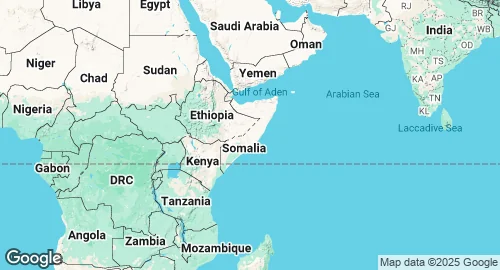
| Capital | Mogadishu |
| Land Area | 627,337 km² |
| Coastline Length | 3,333 km |
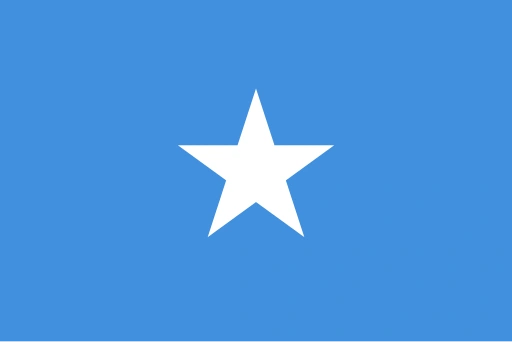
National Flag
Defense Statistics & Key Metrics
| Population | 18.4 million (2023) |
| GDP | $11.0 billion (2023) |
| GDP per capita | $597 (2023) |
| Military Budget | $201.9 million (2024) |
| Share of GDP in Milex | 1.6% (2024) |
| Share of Govt Expenditures | 21.6% (2024) |
| Military spends per capita | $11 (2024) |
| Military Personnel | 14,000 (2020) |
Somali Military Budget History
Population and Military Personnel Trends
GDP and Inflation Rate Trends
Strategic Overview in 2026
Strategic Position
The defense posture of the Federal Republic of Somalia is defined by its transition from a multi-decade reliance on international peacekeeping missions to a sovereign national security architecture. Since January 2025, the primary framework for external security assistance is the African Union Support and Stabilization Mission in Somalia (AUSSOM), which succeeded the African Union Transition Mission in Somalia (ATMIS). Under UN Security Council Resolution 2809, the AUSSOM mandate is authorized through December 2026, maintaining a force ceiling of approximately 11,900 personnel.
Somalia’s strategic priorities are centered on the "Total War" doctrine against the Al-Shabaab insurgency and the protection of territorial integrity. Geopolitical tensions with Ethiopia escalated in 2025 following a memorandum of understanding between Ethiopia and the region of Somaliland regarding port access and naval facilities. In response, Somalia solidified a Strategic Partnership and Defense Pact with Egypt in early 2025, which includes provisions for training, armament, and the deployment of Egyptian military personnel to assist in counterterrorism and border security.
The relationship with Turkey remains a cornerstone of Somali defense. Under a 10-year maritime and defense economic cooperation agreement ratified in 2024 and implemented throughout 2025, Turkey provides naval security within Somalia's Exclusive Economic Zone (EEZ) and assists in the development of the Somali Navy. Bilateral security cooperation also continues with the United States, focused on the training and logistical support of elite infantry units.
Military Forces
The Somali Armed Forces are organized into the Somali National Army (SNA), the Somali Air Force (SAF), and the Somali Navy and Coast Guard. Personnel numbers are estimated at approximately 30,000 to 45,000 active members across all security branches, including the National Intelligence and Security Agency (NISA).
Somali National Army (SNA)
The SNA is an infantry-centric force structured into several brigades with varying levels of specialization. Notable units include: * Danab Advanced Infantry Brigade: A US-trained commando force specialized in precision counterterrorism operations and irregular warfare. * Gorgor (Eagle) Brigade: A Turkish-trained elite unit that forms the backbone of the government’s conventional offensive capabilities.
The army's inventory consists primarily of light and medium equipment tailored for high-mobility counterinsurgency. Following the lifting of the UN arms embargo, the SNA has expanded its fleet of Mine-Resistant Ambush Protected (MRAP) vehicles and Armored Personnel Carriers (APCs). Key equipment includes BMC Kirpi and Casspir MRAPs, BTR-60 and BTR-80 APCs, and a large number of utility "technicals" equipped with heavy machine guns or anti-aircraft cannons.
Somali Air Force and Naval Assets
The Somali Air Force is focused on utility and reconnaissance rather than air superiority. In 2025, the force integrated Bell 412 utility helicopters provided by Italy to enhance medical evacuation and logistical transport. NISA operates Bayraktar TB2 unmanned aerial vehicles (UAVs) for surveillance and close air support.
The Somali Navy is currently undergoing a rebuilding phase with significant Turkish assistance. It operates a fleet of patrol boats and small craft for coastal defense. Under the 2025 maritime pact, joint operations with the Turkish Navy provide a protective umbrella for offshore resource exploration and anti-piracy efforts.
Strategic Trends
The primary strategic trend is the "Somalization" of security, involving the progressive transfer of frontline responsibilities from AUSSOM to the SNA. This transition is supported by an increased defense and security budget, which reached approximately $255 million in 2025. Planning for the 2026 defense budget emphasizes fiscal transparency and the integration of regional "Ma’awisley" clan militias into formal military structures to stabilize newly liberated territories.
Modernization efforts in 2025 and 2026 focus on enhancing lethality and mobility. Procurement priorities include light attack aircraft, additional UAV systems, and advanced communications equipment to improve command and control over fragmented operational theaters.
Significant constraints persist, including the fragility of the federal-state political settlement and a continued reliance on donor funding for personnel stipends. The 2025 Shabelle offensive highlighted the challenges of holding territory against Al-Shabaab’s transition to asymmetric hit-and-run tactics, leading to a doctrinal shift toward more permanent garrisoning of strategic rural hubs.
Frequently Asked Questions
How large is Somalia's military?
What is Somalia's defense budget?
How does Somalia rank militarily in the world?
Does Somalia have nuclear weapons?
What percentage of GDP does Somalia spend on defense?
What is Somalia's military personnel per capita?
Military Expenditure: SIPRI Milex. Suggest a change