Trinidad and Tobago Military Forces
Trinidad and Tobago ranks #146 of 170 militaries worldwide in 2026, with 4,050 active troops. The Air Force flies 2 aircraft. Trinidad and Tobago has no nuclear weapons.
Armed Forces in 2026
| Domain | Strength | Composition |
|---|---|---|
| Trinidad and Tobago Defence Force Air Guard | 2 aircraft | |
| Personnel | 4,050 active |
ATLAS Index (Aggregate Total of Land, Air and Sea strength)
Full ranking →| Pillar | Weight | Score | Basis |
|---|---|---|---|
| Manpower | 10% | 18.9 | Active, reserve & paramilitary personnel |
| Ground forces | 20% | 0.0 | ARMS inventory power: armour & artillery by type and era, attack helicopters, armament |
| Naval power | 20% | 0.0 | SEAS inventory power: hulls by type, size and era, air wing, sustainment, armament |
| Air power | 25% | 10.3 | AIRS inventory power: aircraft by type and generation, enablers, armament |
| Nuclear deterrent | 10% | 0.0 | No declared nuclear capability |
| Defense budget | 15% | 15.7 | Annual spending, purchasing-power adjusted |
| Availability | modifier | ground ×0.98 · naval ×1.00 · air ×1.20 | Budget per point of each force, from the branch indexes |
Country File
| Population | 1.4M (2025) |
| GDP | $25.9 billion (2025) |
| GDP per capita | $18,967 |
| Military budget | $231M (2024) |
| Share of GDP | 0.9% (2024) |
| Military spending per capita | $169 (2024) |
| Inflation rate | 0.99% (2025) |
| Capital | Port of Spain |
| Region | America |
| Land area | 5,128 km² |
| Coastline | 362 km |
| Currency | TTD |
Strategic Overview in 2026
Strategic Position
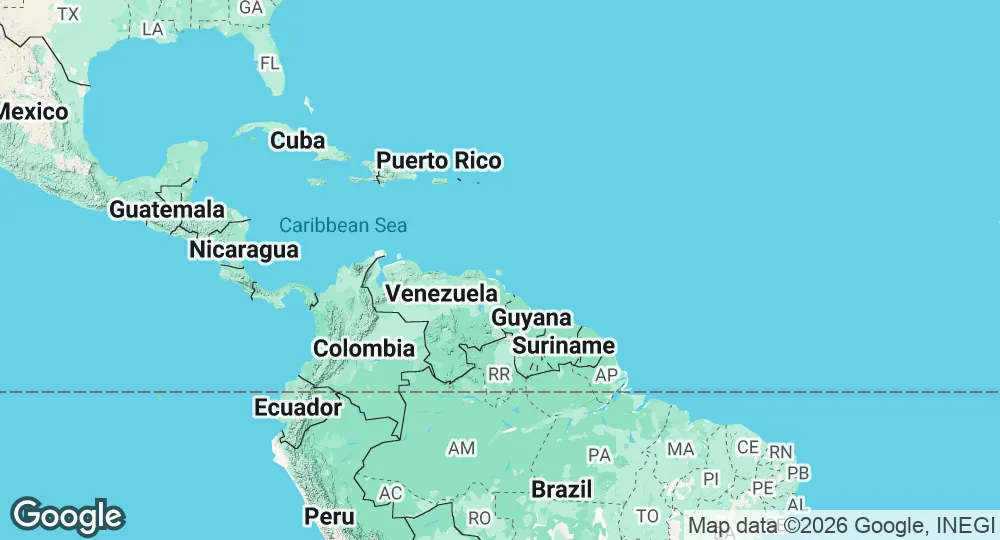
Trinidad and Tobago occupies a maritime-centric position at the southern terminus of the Caribbean archipelago, situated approximately seven miles from the coast of Venezuela. This proximity defines the state’s primary security concerns, which center on the management of the Gulf of Paria and the monitoring of the Columbus Channel to mitigate transnational organized crime. Key threats include maritime smuggling of narcotics and small arms, piracy originating from the South American mainland, and irregular migration patterns.
The nation’s defense doctrine emphasizes territorial integrity, maritime domain awareness, and "Aid to Civil Power" missions, where military assets support the Trinidad and Tobago Police Service (TTPS) in domestic counter-crime operations. Regional security cooperation is conducted primarily through the Caribbean Community (CARICOM) and its Implementation Agency for Crime and Security (IMPACS). While not a full member of the Regional Security System (RSS), the state maintains close operational ties with the organization. Bilateral security relations are focused on the United States, formalized through the Shiprider Agreement, which facilitates joint maritime interdiction and allows for information sharing with U.S. Southern Command (SOUTHCOM). In 2025, the government completed a major administrative realignment, disaggregating the Ministry of National Security to establish a dedicated Ministry of Defence to oversee the armed forces.
Military Forces
The Trinidad and Tobago Defence Force (TTDF) is a volunteer-only organization commanded by the Chief of Defence Staff (CDS). It comprises four primary formations: the Regiment, the Coast Guard, the Air Guard, and the Defence Force Reserves. Personnel levels are approximately 5,000 active-duty members and 600 reservists.
Trinidad and Tobago Regiment The Regiment functions as the primary land component, organized into four battalions, including two infantry battalions, an engineering battalion, and a support and service battalion. Its operational focus is divided between border patrol in southern Trinidad and domestic security assistance. The engineering battalion provides specialized capabilities for disaster response and civil infrastructure support. Standard equipment includes IWI Galil and SIG Sauer assault rifles, supported by light tactical vehicles.
Trinidad and Tobago Coast Guard (TTCG) The TTCG is the largest branch by asset allocation, reflecting the state’s maritime priorities. It is responsible for policing the Exclusive Economic Zone (EEZ) and conducting search and rescue (SAR) and anti-smuggling operations. The fleet includes Austal Cape-class patrol boats and Damen Stan Patrol vessels. The TTCG also operates various rigid-hulled inflatable boats (RHIBs) and interceptors for littoral pursuit.
Trinidad and Tobago Air Guard (TTAG) The Air Guard provides aerial surveillance, logistics, and SAR capabilities. Its fleet consists of AgustaWestland AW139 helicopters and Fairchild C-26 Metroliner fixed-wing aircraft equipped for maritime patrol. Operational readiness in the aviation sector is currently managed through contracted maintenance agreements, following periods of limited serviceability for the rotary-wing fleet.
Strategic Trends
The defense budget remains stable at approximately 1% to 1.3% of GDP. Procurement and infrastructure priorities for 2026 are directed toward enhancing maritime persistence and improving military housing and technical facilities. A central project is the establishment of a new Coast Guard base at the Port of Galeota, designed to increase response times along the southern and eastern coasts. This facility is intended to serve as an integrated logistics hub for naval maintenance, reducing reliance on external dry-docking services.
Modernization efforts within the Regiment are focused on infrastructure upgrades at Teteron Barracks and the acquisition of engineering equipment to support humanitarian assistance and disaster relief (HADR) mandates. The TTDF continues to participate in the annual multinational Exercise Tradewinds, co-hosting the 2025 iteration to improve interoperability with regional partners in maritime interdiction and disaster response.
The military faces ongoing constraints related to the high cost of maintaining sophisticated technical assets and the recruitment of specialized personnel for cyber defense and aviation. Strategically, the TTDF is shifting toward a more integrated joint-force philosophy to streamline command and control between the land and maritime branches during national emergencies.
Military Expenditure: CIA World Factbook. Last updated on 25 September 2026. Suggest a change
Frequently Asked Questions
How large is Trinidad and Tobago's military?
What is Trinidad and Tobago's defense budget?
How does Trinidad and Tobago rank militarily in the world?
Does Trinidad and Tobago have nuclear weapons?
How many aircraft does Trinidad and Tobago's air force have?
What percentage of GDP does Trinidad and Tobago spend on defense?
What is Trinidad and Tobago's military personnel per capita?
- SEP 252026 Updated Population, GDP and inflation added for 2025; GDP series revised
- AUG 42026 Updated Global Military Index updated in a site-wide editorial pass
- JUL 162026 Updated Global Military Index updated in a site-wide editorial pass
- JUN 162026 Updated Yearly statistics, military spending and 2 more fields updated
- JAN 132026 Updated Description added