Flag of American Samoa
Overview
| Country | American Samoa |
| Adopted | 1960 |
| Aspect ratio | 1:2 |
| Colors | |
| Elements | Triangle, eagle |
Description
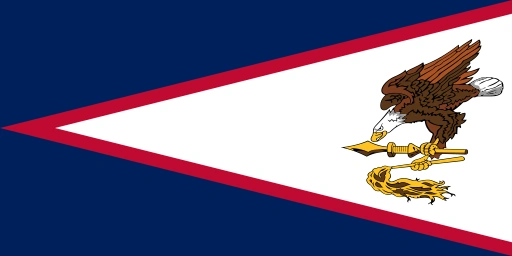
A large blue field contains a white isosceles triangle with a red border, which points from the fly side toward the hoist. Positioned within the white triangle is a brown and white bald eagle shown in flight towards the hoist. The eagle clutches two traditional Samoan symbols, a fly-whisk and a war club, in its yellow talons.
Symbolism
Red, white, and blue signify the historical and political ties shared between American Samoa and the United States. The central bald eagle symbolizes the protection offered by the American government, while its presence highlights the integration of two cultures. Traditional authority is represented by the fue (fly-whisk) held by the eagle, which denotes the wisdom of Samoan chiefs. Conversely, the uatogi (war club) signifies the power and sovereignty of the state in maintaining peace and order.
History
This flag was officially adopted on April 24, 1960, to coincide with the 60th anniversary of the first raising of the United States flag in the territory. Prior to this date, the Stars and Stripes served as the sole official banner after the islands became a U.S. territory in 1900. Local leaders collaborated with the U.S. Army Institute of Heraldry to finalize the design, which has remained unchanged since its inauguration. It was first hoisted during the term of Governor Peter Tali Coleman.