Flag of Bhutan
Overview
| Country | Bhutan |
| Adopted | 1969 |
| Aspect ratio | 2:3 |
| Colors |
Description
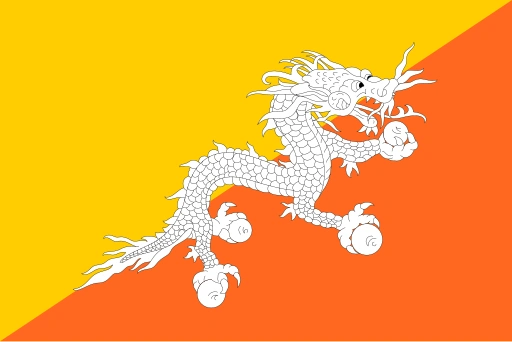
This rectangular banner features a background divided diagonally from the lower hoist-side corner to the upper fly-side corner. An upper yellow triangle and a lower orange triangle form the field, with a large white dragon centered along the dividing line. Positioned facing away from the hoist, the wingless dragon holds a globe-like jewel in each of its four claws.
Symbolism
Yellow signifies the civil tradition and temporal authority of the Druk Gyalpo, while the orange represents the Drukpa Buddhist spiritual traditions. The central white dragon, known as the Druk, symbolizes the purity of inner thoughts and deeds that unite the nation. Jewels held in the dragon's claws represent the wealth and security of the country, while its snarling mouth expresses a commitment to the defense of the deities.
History
The basic design was first developed in 1947 by Mayum Choying Wangmo Dorji for the signing of the Indo-Bhutan Treaty. Originally, the lower half of the flag was red rather than orange, and the dragon faced the hoist. Significant modifications occurred in 1956 to adjust the dragon's placement, and the current version with the orange field was officially standardized in 1969.