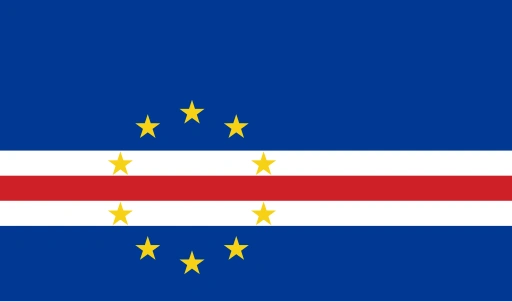
Flag of Cape Verde
Overview
| Country | Cape Verde |
| Adopted | 1992 |
| Aspect ratio | 2:3 |
| Colors | |
| Elements | Stars, horizontal stripes |
Description
Five horizontal bands of blue, white, red, white, and blue comprise the background, with the blue stripes being disproportionately wider than the others. A circle of ten yellow five-pointed stars is centered on the red stripe and shifted toward the hoist side. These stars are positioned over the three central stripes and the lower portion of the uppermost blue field.
Symbolism
The deep blue background represents the Atlantic Ocean and the sky, emphasizing the nation's geographic isolation and maritime character. Ten yellow stars arranged in a circle signify the main islands of the archipelago and the unity of the Cape Verdean people. White stripes symbolize the path toward national construction and peace, while the red stripe represents the hard work and perseverance required to build the country. The circular arrangement further denotes the equality of the islands within the sovereign state.
History
Official adoption of the current design occurred on September 22, 1992, following the country's transition to a multi-party democratic system. Before this change, the nation utilized a flag from 1975 to 1992 that featured the pan-African colors of red, yellow, and green, reflecting the shared history with Guinea-Bissau. The 1991 democratic elections prompted the National Assembly to seek a new visual identity that distanced the state from the previous single-party revolutionary era. This modern design was intended to establish a distinct maritime identity for the archipelago.