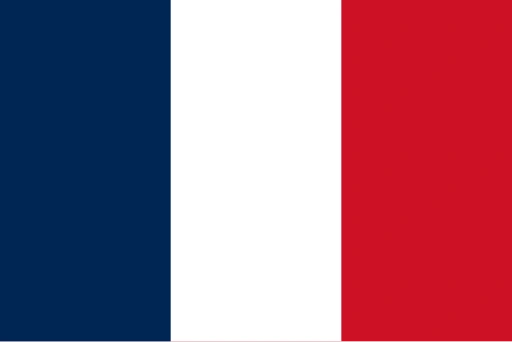
Flag of France
Overview
| Country | France |
| Adopted | 1794 |
| Aspect ratio | 2:3 |
| Colors | |
| Elements | Vertical stripes |
Description
This national ensign consists of three vertical bands of equal width. Arranged from left to right, the stripes are colored blue, white, and red. No additional emblems or symbols are superimposed on the tri-color design.
Symbolism
Blue and red represent the traditional colors of Paris, which were used by revolutionaries on their cockades during the storming of the Bastille. White signifies the ancient color of the French monarchy, positioned between the city's colors to represent the union of the people and the sovereign. Collectively, these hues have come to embody the national motto of 'Liberté, Égalité, Fraternité.' The vertical arrangement distinguishes it from the horizontal stripes used by other European nations of the era.
History
The National Convention officially adopted the current vertical tricolor on February 15, 1794, during the French Revolution. Prior to this design, the French monarchy utilized various flags, most notably a white field adorned with fleurs-de-lis. Although it was briefly replaced by the white Bourbon flag during the Restoration from 1814 to 1830, the tricolor was reinstated following the July Revolution. Jacques-Louis David is often credited with the final arrangement of the colors in their current order.