Flag of Georgia
Overview
| Country | Georgia |
| Adopted | 2004 |
| Aspect ratio | 2:3 |
| Colors | |
| Elements | Cross |
Description
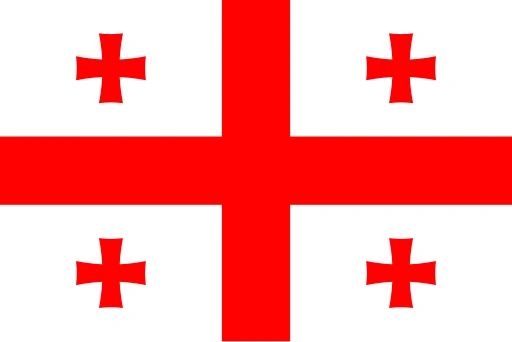
This flag consists of a white rectangular field divided into four quadrants by a large red central cross that extends to the edges. Within each of these four white sections, a smaller red Bolnisi-Katskhuri cross is centrally positioned.
Symbolism
The large central cross represents Saint George, who is the patron saint of the country, while the four smaller crosses are commonly associated with the five holy wounds of Jesus Christ. White is traditionally used to signify innocence, purity, and wisdom. Red elements are intended to symbolize the courage, justice, and love of the Georgian people. Together, the arrangement of the five crosses serves as a testament to Georgia's ancient Christian identity and its historical role in the Caucasus region.
History
The Parliament of Georgia officially adopted this design on January 14, 2004, following the Rose Revolution and the subsequent election of Mikheil Saakashvili. Although it replaced a dark red flag used since the nation's independence from the Soviet Union in 1991, the five-cross pattern dates back to the 14th-century reign of King George V the Brilliant. Historical maps by Franciscan monks and Italian cartographers depicted this banner as the standard of the medieval Georgian kingdom. It served as a symbol of the national opposition movement before being formally reinstated as the state flag.