Flag of Haiti
Overview
| Country | Haiti |
| Adopted | 1986 |
| Aspect ratio | 3:5 |
| Colors | |
| Elements | Horizontal stripes, coat of arms, weapon |
Description
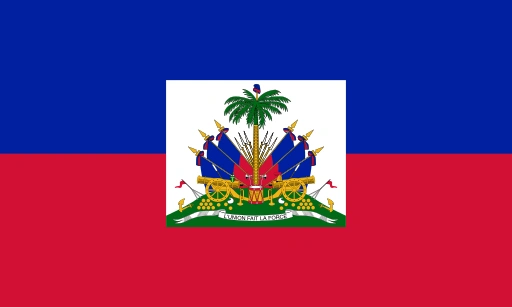
The national flag of Haiti consists of two equal horizontal bands of blue on top and red on the bottom. Centered on the stripes is a white rectangular panel containing the national coat of arms. This emblem features a palm tree flanked by flags, cannons, and various pieces of military equipment on a green lawn.
Symbolism
Blue and red stripes represent the historical union between the Black and multiracial citizens of the nation during the struggle for independence. The central Royal Palm serves as a symbol of liberty, while the surrounding cannons, rifles, and flags denote the military strength required to protect the state. A scroll at the base of the coat of arms displays the national motto, 'L'Union fait la force,' which translates to 'Unity makes strength.'
History
Haiti first created its flag in 1803 when Jean-Jacques Dessalines removed the white stripe from the French Tricolour to symbolize the end of colonial rule. The current horizontal blue and red design was officially readopted on February 25, 1986, following the departure of Jean-Claude Duvalier. This restoration replaced a vertical black and red flag that had been used by the Duvalier regime since 1964.