Flag of Hungary
Overview
| Country | Hungary |
| Adopted | 1957 |
| Aspect ratio | 1:2 |
| Colors | |
| Elements | Horizontal stripes |
Description
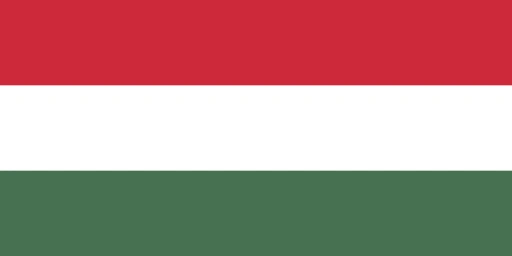
This national flag consists of three equal horizontal stripes arranged from top to bottom. Red occupies the uppermost band, followed by a white center stripe and a green lower stripe. The standard proportions for the state and merchant version are defined as a 1:2 aspect ratio.
Symbolism
Red is traditionally interpreted as representing strength and the blood shed by patriots during the struggle for independence. The central white band signifies faithfulness and the pursuit of peace, while green symbolizes the hope and the fertile land of the nation. These three colors were first documented as a national set in 1608 during the coronation of King Matthias II, reflecting the colors of the Hungarian coat of arms.
History
Although the tricolor design originated during the 1848 revolution against the Habsburgs, it was formally legalized in 1867 following the Austro-Hungarian Compromise. Various iterations of the flag featured different coats of arms in the center, including the Rákosi-era emblem used until the 1956 Revolution. The current version, which omits all central symbols, was officially adopted on May 23, 1957.