Flag of India
Overview
| Country | India |
| Adopted | 1947 |
| Aspect ratio | 2:3 |
| Colors | |
| Elements | Horizontal stripes, circle |
Description
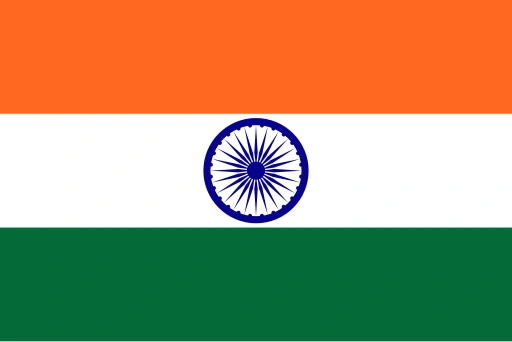
The national flag of India features three equal horizontal bands of saffron at the top, white in the middle, and green at the bottom. Centered within the white band is a navy blue wheel known as the Ashoka Chakra, which contains twenty-four evenly spaced spokes. This rectangular ensign maintains a width-to-length ratio of two to three.
Symbolism
Saffron represents courage and sacrifice, while the white middle band signifies peace, unity, and truth. The green stripe at the base denotes fertility, growth, and the auspiciousness of the land. Positioned in the center, the Ashoka Chakra serves as the wheel of the law, symbolizing motion, progressive change, and the perpetual movement of righteousness.
History
On July 22, 1947, the Constituent Assembly adopted this design as the national flag of the Dominion of India, shortly before the country gained independence from British rule. It was based on the Swaraj flag designed by Pingali Venkayya for the Indian National Congress, which originally featured a spinning wheel in the center. The 1947 modification replaced the spinning wheel with the Dharma Chakra from the Lion Capital of Ashoka to ensure the symbol appeared identical on both sides. Earlier versions used during the independence movement included the 1906 Calcutta flag and the 1921 design presented to Mahatma Gandhi.