Flag of Kiribati
Overview
| Country | Kiribati |
| Adopted | 1979 |
| Aspect ratio | 1:2 |
| Colors | |
| Elements | Horizontal stripes, sun |
Description
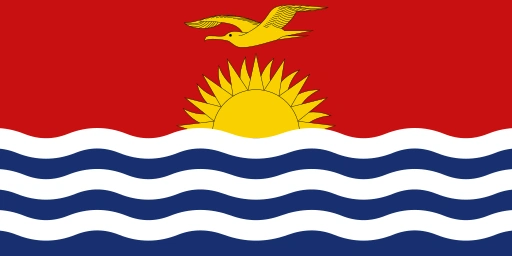
The flag consists of a red upper half and a lower half composed of six alternating wavy stripes in white and blue. Centered in the red field is a yellow frigatebird flying over a rising yellow sun that features seventeen rays. This design follows a 1:2 aspect ratio.
Symbolism
The seventeen sun rays represent the sixteen Gilbert Islands and Banaba, while the rising sun itself denotes the nation's position across the equator. Waves of blue and white symbolize the Pacific Ocean, reflecting the maritime nature of the archipelago. High above the water, the frigatebird serves as a national emblem of power, freedom, and traditional Kiribati culture.
History
Official adoption occurred on July 12, 1979, to mark the country's independence from British colonial rule. The design is derived from the coat of arms originally granted to the Gilbert and Ellice Islands in 1937 by Sir Arthur Grimble. Prior to this, the territory used a British Blue Ensign featuring the colonial badge. Although the Ellice Islands separated to become Tuvalu, Kiribati retained the core heraldic elements of the 1937 shield for its national banner.