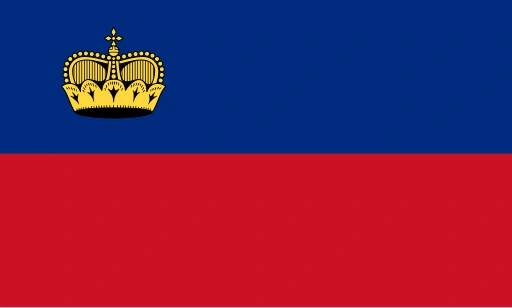
Flag of Liechtenstein
Overview
| Country | Liechtenstein |
| Adopted | 1937 |
| Aspect ratio | 3:5 |
| Colors | |
| Elements | Horizontal stripes, coat of arms |
Description
Two equal horizontal bands of blue and red form the background of this national ensign. Situated in the upper hoist-side corner is a gold princely crown.
Symbolism
According to official interpretations, the blue band represents the radiant sky that arches over the country. The red stripe signifies the embers of the evening fires lit in the mountain homes of the peasantry. Positioned in the canton, the golden crown symbolizes the unity between the people and their monarch. This emblem also serves as a reminder of the nation's status as a principality under the House of Liechtenstein.
History
Blue and red were first officially adopted as national colors in 1852 under Prince Aloys II. During the 1936 Summer Olympics, the nation realized its civil flag was identical to that of Haiti, leading to a design revision. Consequently, the government added the princely crown to the blue stripe in 1937 to distinguish its sovereignty. A slight modification to the crown's design occurred in 1982 to standardize its appearance.