Flag of the Marshall Islands
Overview
| Country | Marshall Islands |
| Adopted | 1979 |
| Aspect ratio | 10:19 |
| Colors | |
| Elements | Stars |
Description
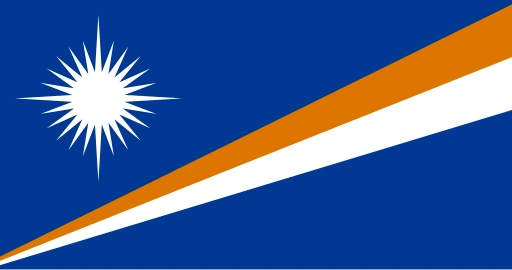
A blue field features two diagonal stripes of orange and white that broaden as they extend from the bottom-left corner toward the top-right corner. Situated in the upper hoist quadrant is a large white star featuring twenty-four points, four of which are significantly longer than the others and arranged in a cardinal pattern.
Symbolism
The blue background represents the Pacific Ocean, while the rising diagonal stripes signify the equator and the nation's continued growth. Orange reflects the Ralik (sunset) island chain and symbolizes courage, whereas the white stripe denotes the Ratak (sunrise) chain and represents peace. Within the star, the twenty-four points correspond to the number of electoral districts, with the four elongated rays representing the major centers of Majuro, Ebeye, Jaluit, and Wotje.
History
First Lady Emlain Kabua designed the current national banner, which was officially adopted on May 1, 1979, during the islands' transition to self-government. Prior to this, the territory flew the flag of the Trust Territory of the Pacific Islands, which featured six stars on a light blue field. The design remained unchanged when the Marshall Islands gained full independence from the United States under the Compact of Free Association in 1986.