Flag of Nicaragua
Overview
| Country | Nicaragua |
| Adopted | 1971 |
| Aspect ratio | 3:5 |
| Colors | |
| Elements | Horizontal stripes, coat of arms |
Description
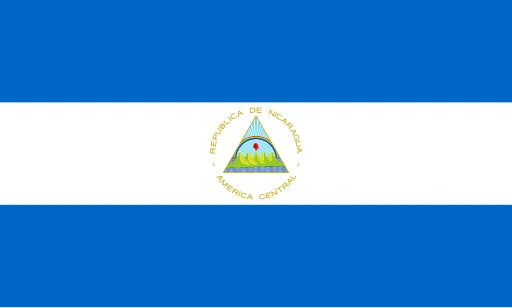
This national ensign features three horizontal stripes of equal width, with cobalt blue bands on the top and bottom and a white band in the center. Positioned in the middle of the white stripe is the national coat of arms, a triangular emblem depicting five volcanoes, a rainbow, and a Phrygian cap. Gold lettering encircling the triangle reads 'REPUBLICA DE NICARAGUA - AMERICA CENTRAL'.
Symbolism
The two blue stripes represent the Pacific Ocean and the Caribbean Sea, while the central white stripe symbolizes the land of the nation and the purity of its ideals. Within the coat of arms, the five volcanoes commemorate the five original member states of the Central American federation. The rainbow above the volcanoes signifies peace, and the Phrygian cap serves as a traditional symbol of liberty and sovereignty.
History
Although the present version was formally adopted on August 27, 1971, the design is based on the 1823 flag of the United Provinces of Central America. Following a period of variation in the mid-19th century, including the use of a horizontal tricolor of yellow, white, and mother-of-pearl, the country reverted to the blue-white-blue pattern in 1908. President José Santos Zelaya played a key role in reinstating the traditional colors to honor the country's federalist heritage. The 1971 legislation finalized the specific proportions and details of the coat of arms currently in use.