Flag of the Philippines
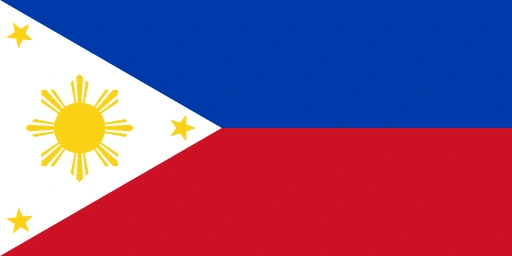
Overview
| Country | Philippines |
| Adopted | 1998 |
| Aspect ratio | 1:2 |
| Colors | |
| Elements | Stars, triangle, sun |
Description
A horizontal bicolor of royal blue and scarlet red is joined at the hoist by a white equilateral triangle. Centered within this triangle is a golden-yellow sun with eight rays, while three five-pointed stars are positioned at each of the triangle's vertices. The overall dimensions of the banner follow a 1:2 aspect ratio.
Symbolism
The white triangle denotes liberty, equality, and fraternity, while the blue and red stripes represent peace and patriotism, respectively. Three stars signify the primary island groups of Luzon, Visayas, and Mindanao. The sun’s eight rays are a tribute to the first eight provinces that initiated the 1896 revolution against the Spanish Empire. In a unique display of national status, the flag is flown with the red stripe on top during times of war to signify a state of conflict.
History
General Emilio Aguinaldo designed the original banner in 1898, which was subsequently sewn in Hong Kong by Marcela Agoncillo and her assistants. It was officially hoisted during the Philippine Declaration of Independence on June 12, 1898, following the defeat of Spanish forces. While the design remained largely consistent over the next century, the shade of blue was formally standardized as royal blue under Republic Act No. 8491 in 1998. Prior to this design, various red banners featuring white symbols were utilized by the Katipunan revolutionary society.