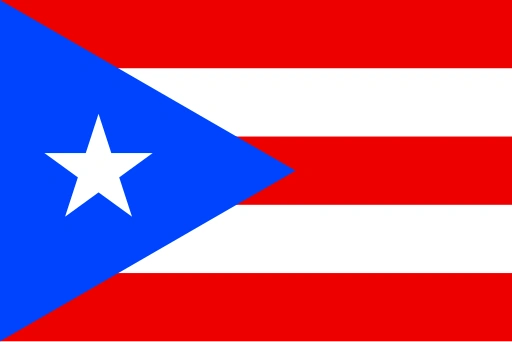
Flag of Puerto Rico
Overview
| Country | Puerto Rico |
| Adopted | 1952 |
| Aspect ratio | 2:3 |
| Colors | |
| Elements | Stars, horizontal stripes, triangle |
Description
Five horizontal stripes of equal height alternate between red and white, beginning and ending with red. A blue isosceles triangle is positioned at the hoist, with its base along the left edge and its apex pointing toward the center. A single white five-pointed star is centered within this blue field.
Symbolism
The three red stripes represent the blood of the brave warriors, while the two white stripes signify victory and the peace attained through independence. A blue triangle is used to denote the three branches of government—executive, legislative, and judicial—as well as the surrounding Caribbean sea and sky. Centered in the triangle, the lone white star represents the island of Puerto Rico. These colors and shapes collectively commemorate the historical struggle for sovereignty and the cultural identity of the Puerto Rican people.
History
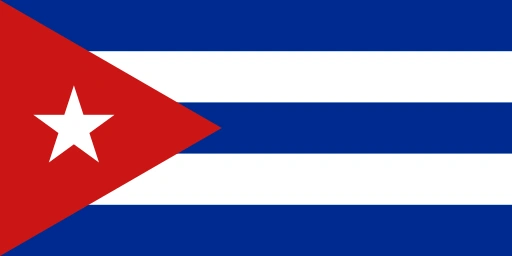
Members of the Puerto Rican Revolutionary Committee first designed this banner in 1895 in New York City as a symbol of defiance against Spanish colonial rule. It was explicitly modeled on the Cuban flag, with the red and blue colors inverted to reflect the fraternal bond between the two independence movements. Although displayed during the 1897 Intentona de Yauco, the flag was illegal to fly under the 1948 Gag Law until its formal adoption by the Commonwealth of Puerto Rico in 1952. Prior to this official status, the Spanish flag and the United States flag were the primary banners used for administrative purposes on the island.