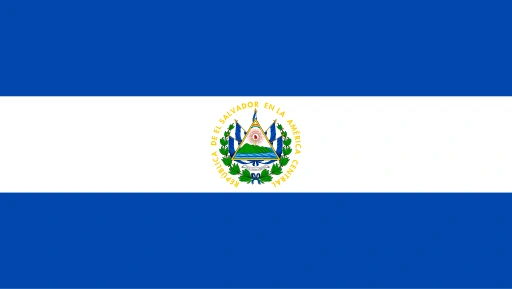
Flag of El Salvador
Overview
| Country | El Salvador |
| Adopted | 1912 |
| Aspect ratio | 189:335 |
| Colors | |
| Elements | Horizontal stripes, coat of arms |
Description
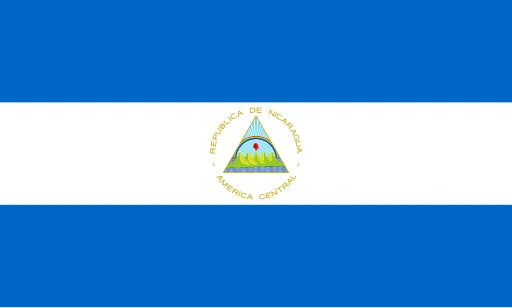
This national ensign consists of three horizontal stripes of equal width, with cobalt blue bands at the top and bottom flanking a central white stripe. Positioned in the center of the white field is the national coat of arms, which features a triangle containing five volcanoes and a Phrygian cap. Yellow text encircles the central emblem, providing the official name of the republic in a circular arrangement.
Symbolism
The two blue stripes represent the Pacific Ocean and the Caribbean Sea, which frame the Central American isthmus. Peace and honesty are represented by the central white stripe, which sits between the two maritime symbols. Within the coat of arms, the five volcanoes commemorate the five original members of the Central American federation, while the yellow elements signify prosperity and the sun's radiance. A Phrygian cap is included to represent the ideal of liberty achieved through national independence.
History
Adopted officially on May 17, 1912, this design was championed by President Manuel Enrique Araujo to honor the country's nineteenth-century heritage. The legislation replaced a flag used since 1865 that featured a field of stars and stripes similar to the United States ensign. By returning to the blue and white triband, the government sought to emphasize El Salvador's historical connection to the United Provinces of Central America. This specific version has remained the primary state symbol for over a century, surviving various constitutional changes.