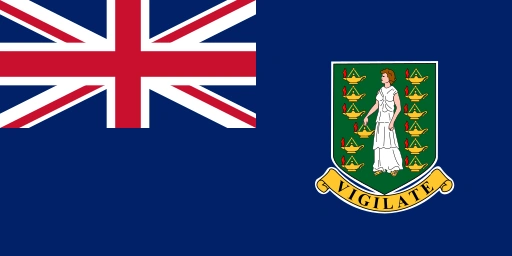
Flag of the British Virgin Islands
Overview
| Country | British Virgin Islands |
| Adopted | 1960 |
| Aspect ratio | 1:2 |
| Colors | |
| Elements | Cross, coat of arms |
Description
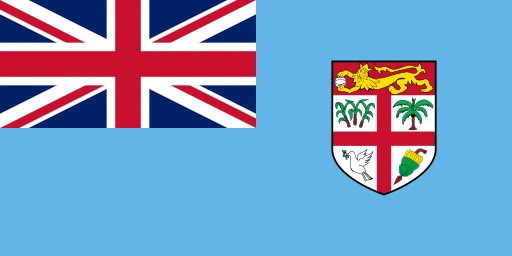
This flag features a dark blue field with the Union Jack positioned in the upper hoist-side quadrant. On the fly side, the coat of arms of the British Virgin Islands is depicted, consisting of a green shield centered with a figure in white holding a lamp. Surrounding this central figure are eleven additional lamps, and a scroll bearing Latin text is situated at the base of the shield.
Symbolism
The central figure on the shield represents Saint Ursula, a religious martyr who, according to tradition, was accompanied by 11,000 companions. Surrounding the saint are eleven lamps, which symbolize those followers and provide a visual reference to the name 'Las Vírgenes' bestowed by Christopher Columbus in 1493. Below the shield, the Latin motto 'Vigilate' translates to 'Be Watchful,' emphasizing a value of constant alertness. The inclusion of the Union Jack in the canton serves to denote the territory's ongoing political links with the United Kingdom.
History
Official adoption of the current flag occurred on November 15, 1960, following the administrative separation of the British Virgin Islands from the Federal Colony of the Leeward Islands. Prior to this date, the territory utilized the Blue Ensign of the Leeward Islands, which featured a distinct colonial badge. In 1999, the design was updated to remove the white circular disc that had previously surrounded the coat of arms, allowing the shield to sit directly on the blue field. This modification followed a directive from the British Ministry of Defence to enlarge the badges on the flags of all overseas territories.