Flag of Vanuatu
Overview
| Country | Vanuatu |
| Adopted | 1980 |
| Aspect ratio | 3:5 |
| Colors | |
| Elements | Triangle |
Description
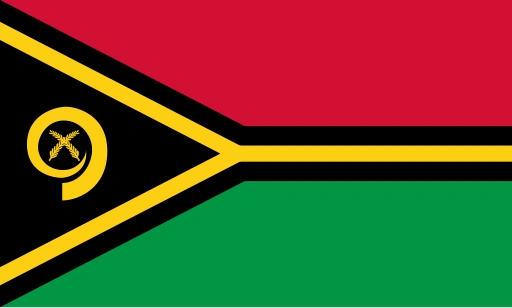
Vanuatu's flag features a horizontal bicolor of red over green. A black triangle is situated at the hoist, containing a thin yellow stripe that divides into two arms that follow the triangle's edges. Within the black triangle is a yellow boar's tusk encircling two crossed namele leaves.
Symbolism
Red represents the blood of boars and men, while green symbolizes the richness of the islands. The black stands for the Melanesian people. Yellow embodies sunshine and the Y-shape represents the archipelago in the Pacific Ocean. The boar's tusk is a symbol of prosperity and is worn as a pendant signifying wealth, while the crossed namele leaves stand for peace.
History
The flag of Vanuatu was officially adopted on February 13, 1980, coinciding with the country's independence from France and the United Kingdom. Prior to independence, the New Hebrides Condominium utilized the flags of both colonial powers. No significant changes have been made to Vanuatu's flag since its initial adoption in 1980.