Brahmaputra-class
Summary
| Origin country | 🇮🇳 India |
| Category | Destroyer |
| Subtype | Guided-missile frigate |
| Manufacturer | Garden Reach Shipbuilders and Engineers |
| Year commissioned | 2000 |
| Units |
F31 INS Brahmaputra F37 INS Beas F39 INS Betwa |
Operators
Technical specifications
| Displacement | 3850 tons |
| Range | 4500 km at 12 knots |
| Crew | 350 members |
| Width | 14.5 m (47.6 ft) |
| Length | 126.4 m (414.7 ft) |
| Air Park |
|
| Propulsion | 2 BHEL Bhopal steam turbines delivering 22,370 kW (30,000 shp) to 2 shafts |
| Thrust | 1500 hp |
| Armament | |
| Maximum speed | 30 knots |
Description
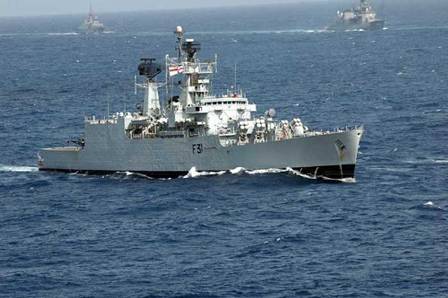
The Brahmaputra class (Project 16A) is a series of guided-missile frigates operated by the Indian Navy. The class originated from a 1986 decision by the Cabinet Committee on Political Affairs to establish an alternative production line for Godavari-class vessels at Garden Reach Shipbuilders and Engineers (GRSE). While the hull and dimensions are similar to the preceding Godavari class, the Indian Navy revised the internal requirements, leading to the finalized Project 16A design in September 1994. The lead ship, INS Brahmaputra, was laid down in 1989 and commissioned in April 2000.
The design utilizes steam turbine propulsion and is configured for operation in environments contaminated by nuclear, chemical, or biological fallout. Sensor systems include Bharat RAWS-03 and RAWL-02 radars for air and surface search, alongside the HUMSA hull-mounted sonar array and Thales Sintra towed array sonar. Command and control functions are managed via the Electronic Modular Command & Control Applications (EMCCA) system, an indigenous action information package that integrates data from Indian, Russian, and Western sensors and weapons. INS Betwa served as the validation platform for these integrated combat data systems.
Armament for the class includes Kh-35 anti-ship missiles and Barak point-defense surface-to-air missiles. Defensive gunnery is provided by an OTO Melara main gun and AK-630 Gatling guns, which are directed by BEL Shikari opto-electronic trackers. For anti-submarine warfare, the vessels employ ILAS 3 torpedo tubes and can embark two Sea King Mk.42B helicopters or a combination of Sea King and HAL Chetak aircraft.
The class consists of three ships: Brahmaputra, Betwa, and Beas. Service history has been marked by two major dockyard accidents. In December 2016, INS Betwa tipped over during undocking at the Mumbai Naval Dockyard. In July 2024, INS Brahmaputra sustained fire damage at the same location and subsequently listed onto its side. In October 2023, the Ministry of Defence contracted Cochin Shipyard Limited to perform a mid-life upgrade on INS Beas. This upgrade, which commenced in April 2024, involves converting the propulsion system from steam turbines to a diesel (CODAD) configuration to reduce maintenance requirements and extend the service life of the vessels. Similar upgrades are planned for the remaining ships in the class.