Delta III-class
Summary
| Origin country | 🇨🇳 Ex-USSR |
| Category | Submarine |
| Subtype | Nuclear-powered ballistic missile submarine |
| Manufacturer | Komsomolsk-on-Amur |
| Year commissioned | 1972 |
| Unit | Orenburg |
Technical specifications
| Displacement | 7800 tons |
| Displacement submerged | 10000 tons |
| Range | Unlimited, except by food supplies |
| Endurance | 80 to 90 days autonomy |
| Crew | 120 members |
| Width | 12.0 m (39.4 ft) |
| Length | 139.0 m (456.0 ft) |
| Max. depth | 320 m (1049.9 ft) |
| Propulsion | 2 pressurized water-cooled reactors powering 2 steam turbines driving 2 shafts and each developing 38.7 MW (51,900 shp) |
| Armament |
|
| Maximum speed | 12 knots |
| Max. speed submerged | 25 knots |
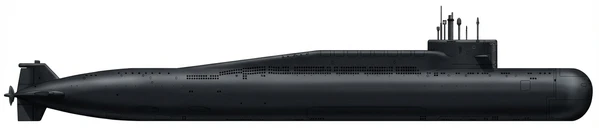
Description
Development of the Project 667BDR Kalmar, designated Delta III by NATO, began in 1972 at the Rubin Central Design Bureau for Marine Engineering. The class represents an iterative development of the Project 667 series, following the Delta I and Delta II designs. The Severodvinsk shipyard conducted construction of the vessels during the 1970s and 1980s, with the first unit entering service in 1976.
The Delta III features a double-hull construction consisting of a low-magnetic steel outer hull and a thicker internal pressure hull. This class was the first submarine capable of launching its ballistic missiles in a single salvo. It also introduced the capacity to carry missiles equipped with multiple independently targetable reentry vehicles (MIRVs). The range of the R-29R missiles enabled these submarines to conduct deterrence patrols within the Arctic Ocean. This operational capability allowed the vessels to reach targets without passing through sonar barriers in the GIUK gap.
During the Soviet era, the Delta class served as a primary component of the strategic submarine fleet. Following the dissolution of the Soviet Union in 1991, several Delta III units were retained by the Russian Navy, though others were decommissioned due to budget constraints. By 2023, two vessels remained in the fleet: the K-44 Ryazan and the BS-136 Orenburg. The Orenburg operates as a heavily modified special-purpose platform. Other vessels in the family have been converted for special-purpose roles under the GUGI.