Delta IV-class
Summary
| Origin country | 🇨🇳 Ex-USSR |
| Category | Submarine |
| Subtype | Nuclear-powered ballistic missile submarine |
| Manufacturer | Komsomolsk-on-Amur |
| Year commissioned | 1972 |
| Units |
Podmoskovye K-114 Tula K-117 Bryansk K-18 Karelia K-407 Novomoskovsk K-51 Verkhoturye |
Technical specifications
| Displacement | 7800 tons |
| Displacement submerged | 10000 tons |
| Range | Unlimited, except by food supplies |
| Endurance | 80 to 90 days autonomy |
| Crew | 120 members |
| Width | 12.0 m (39.4 ft) |
| Length | 139.0 m (456.0 ft) |
| Max. depth | 400 m (1312.3 ft) |
| Propulsion | 2 pressurized water-cooled reactors powering 2 steam turbines driving 2 shafts and each developing 38.7 MW (51,900 shp) |
| Armament |
|
| Maximum speed | 12 knots |
| Max. speed submerged | 25 knots |
Description
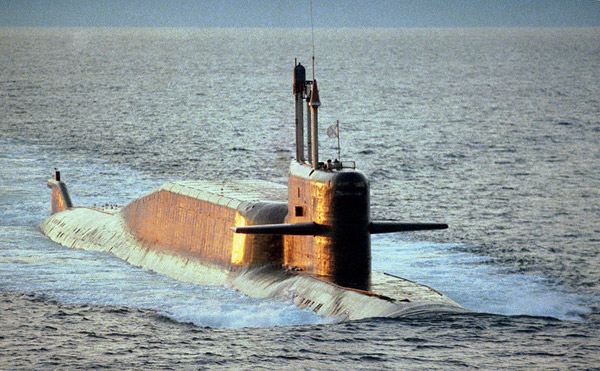
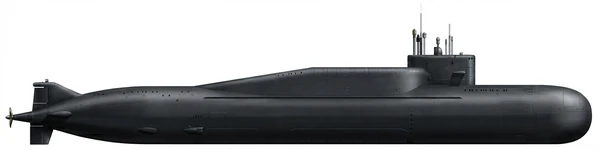
Project 667BDRM Delfin, designated by NATO as the Delta IV, is a class of nuclear-powered ballistic missile submarines. Developed as an iterative improvement of the Project 667 series, the class followed the Delta III and Typhoon classes. The SEVMASH shipyard in Severodvinsk constructed these vessels to carry the R-29RM family of missiles. The range of these weapons allowed the submarines to conduct patrols within the Arctic Ocean rather than approaching foreign coastlines to reach targets, thereby avoiding sonar barriers.
The design utilizes two pressurized water-cooled reactors and two steam turbines driving fixed-pitched shrouded propellers. The class is equipped with the D-9RM launch system, which allows for the firing of liquid-fueled ballistic missiles in a single salvo. These vessels can launch missiles from a constant course within a circular sector while submerged. The TRV-671 RTM missile-torpedo system provides secondary armament, with bow-mounted tubes that accommodate torpedoes, anti-submarine missiles, and anti-hydroacoustic devices. Combat operations are coordinated via the Omnibus-BDRM battle management system. Navigation and missile accuracy are supported by the Shlyuz system, which is capable of stellar navigation at periscope depth. The class also employs the Skat-VDRM hydroacoustic system and two floating antenna buoys for receiving satellite and radio signals while submerged.
The submarines transitioned from the Soviet Navy to the Russian Federation and are assigned to the Northern Fleet. Initially based at Olenya Bay and Sayda Guba, the vessels now operate out of Yagelnaya Bay. During Operation Behemoth, a Delta IV became the only ballistic missile submarine class to fire its entire missile load in a single salvo. Throughout their service life, several hulls have undergone modernization to carry Sineva and Layner missiles, which feature improved survivability against anti-ballistic missile systems. Service history includes the conversion of BS-64 Podmoskovye into a special-purpose platform, a process that involved removing its missile silos. K-84 Ekaterinburg was deactivated in 2020 following a fire and subsequent repair period. Most vessels of the class remain in active service.