Foxtrot-class
Summary
| Origin country | 🇨🇳 Ex-USSR |
| Category | Submarine |
| Subtype | Diesel-electric patrol submarines |
| Manufacturer | Sudomekh |
| Year commissioned | 1958 |
| Units | B-94, B-95, B-36, B-37, B-133, B-135, B-139, B-116, B-130, B-85, B-59, B-156, B-153, B-164, B-33, B-105, B-169, B-38, B-53, B-50, B-8, B-31, B-2, B-55, B-98, B-101, B-6, B-103, B-109, B-107, B-112, B-25, B-205, B-143, B-15, B-427, B-39, B-440, B-435, B-9, B-4, B-57, B-7, B-21, B-26, B-28, B-34, B-40, B-29, B-41, B-46, B-49, B-397, B-400, B-413, B-416, B-213, B-409 |
Technical specifications
| Displacement | 1983 tons |
| Displacement submerged | 2515 tons |
| Range | 20000 km at 8 knots |
| Endurance | 10 |
| Crew | 78 members |
| Width | 7.4 m (24.3 ft) |
| Length | 89.9 m (294.9 ft) |
| Max. depth | 296 m (971.1 ft) |
| Propulsion | 3 × Kolomna 2D42M 2,000 hp (1,500 kW) diesel engines; 3 × Electric motors (two 1,350 hp and one 2,700 hp); 1 × 180 hp auxiliary motor; 3 shafts |
| Armament |
|
| Maximum speed | 16 knots |
| Max. speed submerged | 15 knots |
Description
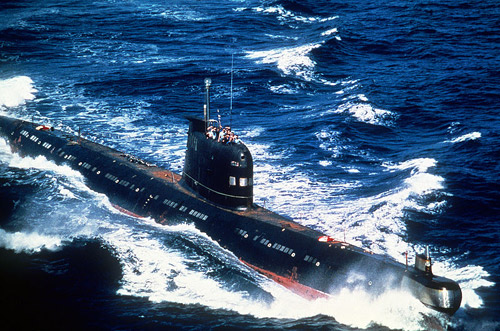
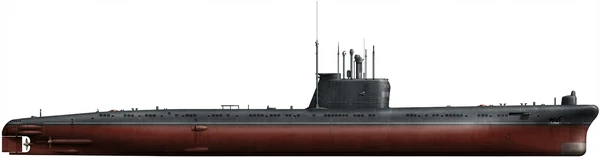
The Foxtrot class, designated Project 641 by the Soviet Union, was a class of diesel-electric patrol submarines developed to replace the earlier Zulu class. The design addressed structural weaknesses and harmonic vibration issues that had restricted the operational depth and submerged speed of its predecessor. Construction took place at the Sudomekh division of the Admiralty Shipyard in Leningrad. The first vessel was laid down in 1957 and commissioned in 1958, with production continuing until 1983.
The design utilized a three-shaft propulsion system with six-bladed propellers. Project 641 was among the final Soviet designs introduced before the adoption of the teardrop hull, and its three-screw configuration made the class noisier than contemporary Western submarines. The internal layout featured three decks, two of which were dedicated to batteries. This configuration provided extended underwater endurance, though the weight of the batteries limited average speed during maximum submerged operations. Onboard conditions were characterized by restricted internal space and crowded living quarters for the complement.
A total of 75 units were completed. While the majority served in the Soviet Navy, the class was also exported to the navies of India, Libya, and Cuba. India operated variants known as the Kalvari and Vela classes. Following the dissolution of the Soviet Union, vessels were operated by the Russian, Polish, and Ukrainian navies.
The class was deployed during the Cuban Missile Crisis in 1962, when four Project 641 submarines from the Sixty-Ninth Submarine Brigade—B-4, B-36, B-59, and B-130—were sent to the region. During the crisis, US Navy destroyers used practice depth charges to force the submarines to surface for identification. Three of the four vessels were forced to surface, while one evaded US forces. All four were eventually ordered to return to Soviet ports.
The Russian Navy retired its last Foxtrot units between 1995 and 2000. In 1997, one vessel was transferred to Ukraine and renamed the Zaporizhzhia. This submarine was later captured by Russian forces during the 2014 annexation of Crimea. Several units are preserved as museum ships, with examples located in Russia, India, the United Kingdom, and the United States.