Hotel-class
Summary
| Origin country | 🇨🇳 Ex-USSR |
| Category | Submarine |
| Subtype | Nuclear-powered ballistic missile submarine |
| Manufacturer | Severodvinsk State Shipyard 402 |
| Year commissioned | 1960 |
| Units | K-19, K-33/K-54, K-55, K-40, K-16, K-145, K-149, K-178 |
Operators
Technical specifications
| Displacement | 4095 tons |
| Displacement submerged | 5588 tons |
| Range | Unlimited, except by food supplies |
| Crew | 104 members |
| Width | 9.2 m (30.2 ft) |
| Length | 114.0 m (374.0 ft) |
| Propulsion | 2 × pressurized water reactors, 2 shafts |
| Armament |
|
| Maximum speed | 18 knots |
| Max. speed submerged | 26 knots |
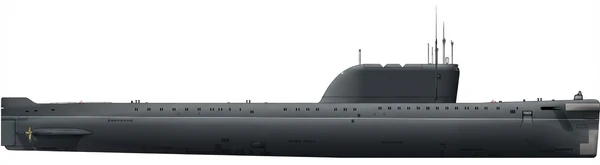
Description
The Hotel class, designated Project 658 by the Soviet Union, was a series of nuclear-powered ballistic missile submarines. Development was approved in August 1956, and the technical project reached completion in early 1957. The design utilized the hull of the Project 627 November-class nuclear submarine and integrated the missile compartment from the diesel-electric Golf class. All eight vessels were constructed at the SEVMASH shipyard in Severodvinsk. This class followed the Golf class and was succeeded by the Yankee class.
The design featured horizontal hydroplanes and electro-hydraulic command control surfaces for underwater operations. The initial Hotel I configuration utilized the D-2 launch system, which housed missiles in vertical containers located behind the sail. This configuration required the submarine to surface for missile launches. Between 1961 and 1963, seven of the eight vessels were converted to the Hotel II standard. This update replaced the D-2 with the D-4 launch system, enabling submerged missile launches. This modification required the flooding of the launch tubes prior to firing. One vessel, K-145, was further modified under Project 701 to the Hotel III configuration to test the R-29 missile system, a process that required lengthening the hull.
The lead ship, K-19, was laid down in 1958 and entered service in 1960. The remaining seven vessels were commissioned between 1960 and 1962. Throughout their service with the Soviet Navy, the vessels underwent the aforementioned conversions to the Hotel II and Hotel III standards. The modified K-145 returned to combat service in 1976 following its missile testing trials. The class remained in commission through the late Cold War period. Decommissioning of the vessels began in 1987, and the final units were retired from service in 1991 for scrapping.