La Combattante II-class
Summary
| Origin country | 🇫🇷 France |
| Category | Patrol vessel |
| Subtype | Fast attack craft |
| Manufacturer | Constructions Mécaniques de Normandie |
| Year commissioned | 1968 |
| Units |
P221 IRIS Kaman P222 IRIS Xoubin P223 IRIS Khadang P226 IRIS Falakhon P227 IRIS Shamshir P228 IRIS Gorz P229 IRIS Gardouneh P230 IRIS Khanjar P231 IRIS Neyzeh P232 IRIS Tabarzin |
Technical specifications
| Displacement | 234 tons |
| Length | 47.0 m (154.2 ft) |
| Armament |
|
| Maximum speed | 36 knots |
Description
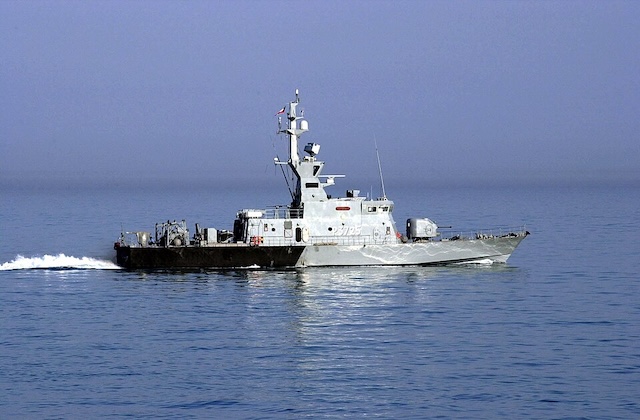
The La Combattante II is a class of fast attack craft produced in France for export during the 1970s. The type originated from a joint venture between the German and French governments to combine a Lürssen-designed hull with Aerospatiale Exocet missiles. Although originally intended for Israel, the French government required the design to be handled by Constructions Mécaniques de Normandie (CMN) in Cherbourg. The initial production run of 20 vessels was transferred to the German Bundesmarine as the Tiger class due to political considerations. Between 1968 and 1974, CMN built an additional 37 vessels for export under the La Combattante II designation, named after the patrol craft used for Exocet missile trials.
The design features a hull produced by CMN with a configuration that typically includes a main gun mounted forward, missile launchers in box launchers amidships, and a secondary gun aft. Internal equipment and specific armament varied according to the requirements of the purchasing navies. Israel operated 12 vessels of a similar design, categorized as the Sa'ar 1, 2, and 3 classes. The Sa'ar 1 and 2 variants included anti-submarine provisions and sonar, while the Sa'ar 3 variant prioritized gunnery and missiles. Iran later developed a domestic, upgraded version of the design known as the Sina class.
The class saw service with several international navies. The German Tiger-class vessels were eventually sold to Greece, Chile, and Egypt. Malaysia commissioned four Perdana-class ships in 1972 and 1973. Libya operated ten vessels known as the Beir Grassa class. Iran ordered 12 Kaman-class ships; nine were delivered between 1977 and 1978, while the remaining three entered service in 1981.
Operational history includes engagements involving Libyan and Iranian vessels. In 1980, the Iranian craft Paykan was sunk during Operation Morvarid. In 1986, one Libyan Beir Grassa-class vessel was sunk and another disabled during a confrontation with United States forces. In 1988, the Iranian vessel Joshan was sunk by the USS Simpson during Operation Praying Mantis. As of 2012, Iran continued to operate the Kaman class and had commissioned four domestically built Sina-class vessels.