Leopard-class
Summary
| Origin country | 🇧🇩 Bangladesh |
| Category | Frigate |
| Subtype | Air-defence frigate |
| Manufacturer | HM Dockyard, Portsmouth |
| Year commissioned | 1957 |
| Units | HMS Leopard, HMS Lynx, HMS Puma, HMS Jaguar, INS Brahmaputra, INS Beas, INS Betwa |
Operators
Technical specifications
| Displacement | 2337 tons |
| Range | 7500 km at 16 knots |
| Crew | 205 members |
| Width | 12.0 m (39.4 ft) |
| Length | 100.0 m (328.1 ft) |
| Propulsion | 8 × Admiralty Standard Range ASR1 diesels, 14,400 shp (10,738 kW), 2 shafts |
| Thrust | 1500 hp |
| Armament |
|
| Maximum speed | 24 knots |
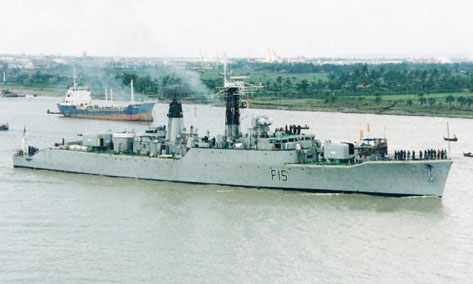
Description
The Leopard class, or Type 41, was a class of anti-aircraft frigates developed for the Royal Navy. The design was finalized in 1947 as part of a 1945 project for a series of frigates sharing a common hull and propulsion system. Built between 1953 and 1960, the class entered service with the Royal Navy and the Indian Navy. Production was eventually curtailed in favor of the Type 12 frigate following developments in steam turbine technology.
These vessels utilized diesel propulsion with Admiralty Standard Range diesel engines connected to drive shafts via fluid clutches and reduction gearboxes. This machinery provided extended range and lower fuel consumption compared to earlier designs. The design incorporated a hydraulic stabilizer system consisting of retractable fins to manage ship roll. The Type 41 was equipped with a radar suite for surface target indication and air warning, alongside search and attack sonar systems. The main armament consisted of twin semi-automatic gun turrets and an anti-submarine mortar battery.
In Royal Navy service, the class operated as patrol frigates on the South American station, based at Simonstown, and in the Far East during the confrontation with Indonesia between 1963 and 1968. The ships were also deployed during the Cod Wars of the 1970s. HMS Leopard participated in the 1975–1976 conflict, while HMS Lynx was the last of the class to remain operational in British service. HMS Jaguar was reactivated for the Third Cod War but returned to port after developing leaks. The Indian Navy operated three vessels, which were decommissioned between 1986 and 1992. Two units were sold to the Bangladesh Navy in 1978 and 1982, where they remained in service until 2013.