Oscar II-class
Summary
| Origin country | 🇨🇳 Ex-USSR |
| Category | Submarine |
| Subtype | Nuclear-powered cruise missile submarine |
| Manufacturer | Sevmash |
| Year commissioned | 1980 |
| Units |
K-132 Irkutsk K-150 Tomsk K-186 Omsk K-266 Orel K-329 Belgorod K-410 Smolensk K-442 Chelyabinsk K-456 Tver |
Operators
Technical specifications
| Displacement | 12500 tons |
| Displacement submerged | 16500 tons |
| Range | Unlimited, except by food supplies |
| Endurance | 120 |
| Crew | 94 members |
| Width | 18.2 m (59.7 ft) |
| Length | 155.0 m (508.5 ft) |
| Max. depth | 520 m (1706.0 ft) |
| Propulsion | 2 × pressurized water cooled reactors, HEU ≤ 45%; 2 × steam turbines delivering 73,070 kW (97,990 shp) to two shafts |
| Armament |
|
| Maximum speed | 15 knots |
| Max. speed submerged | 32 knots |
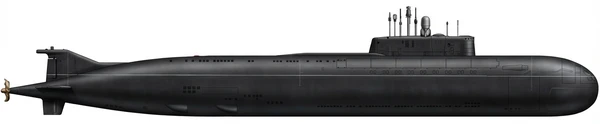
Description
The Oscar class, designated Project 949 Granit and Project 949A Antey, consists of nuclear-powered cruise missile submarines designed by the Soviet Union. The first Project 949 vessel was laid down in 1975 and entered service in 1980. The Project 949A variant replaced the original design in 1982. These submarines were developed to target NATO carrier battle groups using long-range anti-ship missiles and targeting data provided by the EORSAT satellite system.
The class utilizes a double-hull construction. Project 949A is longer than the original Project 949 design to accommodate quieter propulsion systems and updated electronics. Design features include a seven-blade propeller, a large fin, and a VSK emergency crew escape capsule located within the fin structure. The vessels are equipped with both an open bridge on the sail and an enclosed bridge for use in inclement weather. A specialized variant, Project 09852 Belgorod, was reconfigured from an incomplete Project 949A hull to serve as a research and special operations platform capable of carrying unmanned underwater vehicles.
The Soviet and Russian Navies deployed the Oscar class to the Northern and Pacific Fleets. Following the dissolution of the Soviet Union, the Russian Navy maintained the class in active service while retiring older submarine designs. Fourteen submarines were completed, including two Project 949 vessels and eleven Project 949A vessels. Six units remain active in the current Russian fleet, while four have been retired and two are laid up. The K-141 Kursk was lost in 2000.
A modernization program for the class, designated Project 949AM, began in 2011. This involves upgrading the combat information, navigation, fire-control, and sonar systems. The Project 09852 Belgorod was delivered to the Russian Navy in 2022. Several other units, including the K-132 Irkutsk and K-442 Chelyabinsk, have been assigned to shipyards for repair and system updates to extend their service lives.