Ropucha-class (Project 775)
Summary
| Origin country | 🇨🇳 Ex-USSR |
| Category | Amphibious vessel |
| Subtype | Landing ship |
| Manufacturer | Stocznia Północna Shipyard |
| Year commissioned | 1974 |
| Units |
012 Olenegorsky Gornyak 016 Georgiy Pobedonosets 027 Kondopoga 031 Aleksandr Otrakovsky 066 Oslyabya 077 Peresvet 102 Kaliningrad 110 Aleksandr Shabalin 130 Korolyov 151 Azov 156 Yamal |
Technical specifications
| Displacement | 4080 tons |
| Range | 6100 km at 15 knots |
| Endurance | 30 |
| Crew | 98 members |
| Width | 15.0 m (49.2 ft) |
| Length | 112.5 m (369.1 ft) |
| Propulsion | 2 × 9,600 hp (7,200 kW) Zgoda-Sulzer 16ZVB40/48 diesel engines |
| Armament |
|
| Maximum speed | 18 knots |
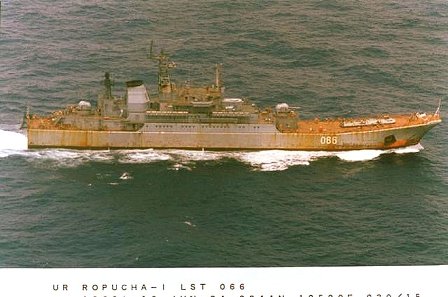
Description
The Ropucha class, Soviet designation Project 775, is a series of landing ships built for the Soviet Navy at the Stocznia Północna Shipyards in Gdańsk, Poland. Developed to succeed the Polnocny class, these vessels entered service starting in 1975. The class consists of the baseline Project 775 (Ropucha I) and the improved Project 775M (Ropucha II), which features modified armament and increased troop accommodation. A total of 28 ships were completed through 1991.
These vessels are designed specifically for beach landings and roll-on/roll-off operations. They feature both bow and stern ramps to facilitate the loading and unloading of vehicles. The vehicle deck extends the full length of the hull, and a sliding hatch-cover located above the bow section allows for loading via dockside cranes. The ships are configured to carry main battle tanks, armored personnel carriers, or cargo, alongside embarked troops. The design does not include facilities for helicopter operations.
The Russian Navy inherited the majority of the class following the dissolution of the Soviet Union. Other operators have included the Ukrainian Navy and the Yemeni Navy; South Yemen received one vessel in 1979, which served until 2002 before its conversion into a civilian cargo ship.
Operational service includes the Russo-Georgian War, where vessels landed troops at the port of Poti. From 2013, ships from all four Russian fleets were utilized for the transport of military equipment to Tartus during the intervention in the Syrian civil war. In 2014, Russian forces seized the Ukrainian vessel Kostiantyn Olshansky during the occupation of Crimea.
During the full-scale invasion of Ukraine beginning in 2022, Ropucha-class ships from the Baltic and Northern fleets were redeployed to the Black Sea. Several vessels have been damaged or destroyed during the conflict. The Novocherkassk and Tsezar Kunikov were damaged at Berdiansk in 2022; the Novocherkassk was subsequently destroyed by an air strike in 2023, and the Tsezar Kunikov was reported sunk by naval drones in 2024. The Olenegorsky Gornyak was damaged by a maritime drone at Novorossiysk in 2023, while the Minsk was heavily damaged by a missile strike in Sevastopol. In March 2024, Ukrainian forces reported missile strikes against the Yamal, Azov, and the seized Konstantin Olshansky.