Sierra-class
Summary
| Origin country | 🇨🇳 Ex-USSR |
| Category | Submarine |
| Subtype | Nuclear attack submarine |
| Manufacturer | Krasnoye Sormovo |
| Year commissioned | 1984 |
| Units |
K-336 Nizhny Novgorod K-534 Pskov PO-141 Sierra PO-143 Prierto PO-144 Romero |
Technical specifications
| Displacement | 7200 tons |
| Displacement submerged | 8300 tons |
| Range | Unlimited, except by food supplies |
| Crew | 61 members |
| Width | 12.28 m (40.3 ft) |
| Length | 107.16 m (351.6 ft) |
| Max. depth | 600 m (1968.5 ft) |
| Propulsion | 1 × PWR, 190 MW (HEU <= 45%), 2 × 1,002 hp (747 kW) emergency motors, 1 shaft, 2 spinners |
| Armament | |
| Maximum speed | 10 knots |
| Max. speed submerged | 34 knots |
Description
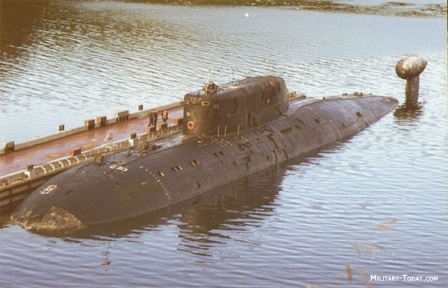
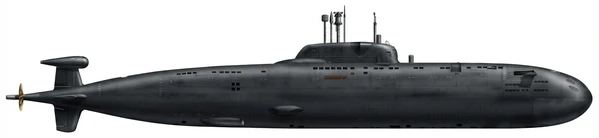
The Sierra class, designated Project 945 Barrakuda and Project 945A Kondor, consists of nuclear-powered attack submarines built for the Soviet Navy and currently operated by the Russian Navy. Developed as a third-generation successor to the Alfa and Victor classes, the series was constructed between 1979 and 1992 at the Krasnoye Sormovo shipyard. Four of five planned vessels were completed. The Akula class was produced as a steel-hulled alternative due to the costs and technical difficulties associated with titanium construction.
The class utilizes a titanium pressure hull, which allows for operations at greater depths and provides increased resistance to torpedo attacks compared to steel hulls. The use of titanium also reduces radiated noise. Propulsion is provided by a single OK-650 pressurized water reactor. Sierra I vessels incorporate a releasable escape pod in the sail, identified by a V-shaped casing. The Sierra II variant features a sail five meters longer than the Sierra I, incorporating a flat, square leading edge and two escape pods. Sierra II boats also include a 10-point environment sensor and a larger pod on the after fin to house the Skat 3 passive low-frequency towed sonar array. This variant was designed with improved quieting and sonar for search and destroy missions against nuclear submarines.
The first Sierra I vessel, Carp, entered service in 1984 and was laid up in 1997. The second, Kostroma, entered service in 1987. In February 1992, Kostroma collided with the USS Baton Rouge in the Barents Sea; the vessel was repaired and returned to the fleet by June 1992. Both Sierra I hulls were in the reserve fleet as of 2019. A planned modernization for these vessels, intended to include Kalibr cruise missiles and GLONASS navigation systems, was suspended in 2015 due to cost concerns.
Two Sierra II vessels, Nizhniy Novgorod and Pskov, entered service in 1990 and 1993, respectively. These boats remain active and participated in naval exercises in 2019. As of 2024, the Sierra II submarines are located at the Nerpa shipyard for modernization of internal systems. A single Project 945AB hull was laid down in 1990 but was scrapped in 1993 before completion.