Alfa-class
Summary
| Origin country | 🇨🇳 Ex-USSR |
| Category | Submarine |
| Subtype | Nuclear attack submarine |
| Manufacturer | Admiralty yard, Leningrad |
| Year commissioned | 1971 |
| Units | K-64, K-123, K-316, K-432, K-373, K-493, K-463 |
Operators
Technical specifications
| Displacement | 2300 tons |
| Displacement submerged | 3200 tons |
| Range | Unlimited, except by food supplies |
| Crew | 31 members |
| Width | 9.5 m (31.2 ft) |
| Length | 81.4 m (267.1 ft) |
| Max. depth | 400 m (1312.3 ft) |
| Propulsion | OK-550 or BM-40A, 155-MWt Lead-bismuth cooled, beryllium-moderated reactor; 40,000 shp (30,000 kW) steam turbine, one shaft |
| Armament |
|
| Maximum speed | 12 knots |
| Max. speed submerged | 41 knots |
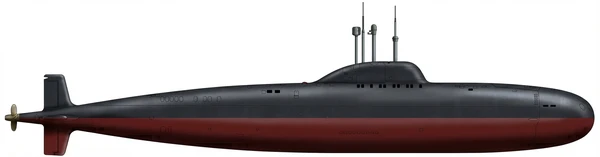
Description
Project 705 Lira, designated Alfa by NATO, originated from a 1957 proposal by M. G. Rusanov. Design work began in May 1960 at SKB-143 in Leningrad. The project aimed to develop a high-speed interceptor capable of pursuing surface vessels and engaging in underwater combat. Initial requirements for a very small vessel with a minimal crew were modified in 1963 to increase dimensions and crew complement due to practical engineering challenges. Seven vessels were completed between 1968 and 1981 at the Admiralty yard in Leningrad and the Sevmash yard in Severodvinsk.
The class featured a double-hull construction utilizing titanium alloy for the pressure hull. This material was selected to reduce weight and magnetic signature. Propulsion was provided by a lead-bismuth liquid metal cooled, beryllium-moderated reactor. Two reactor models were utilized: the OK-550 and the BM-40A. These plants were smaller than conventional pressurized water reactors, allowing for a more streamlined hull. Because the lead-bismuth coolant solidifies at temperatures below 125°C, the reactors required continuous external heating with superheated steam when shut down.
Design characteristics emphasized automation to reduce the necessary crew. Integrated systems included the Akkord combat information and control system, the Sargan weapon control system, and the Ritm system for machinery control. These automated suites allowed for all primary operations to be conducted from a central control room. The internal pressure hull was divided into six watertight compartments. The third compartment was the only manned space during standard operations and featured reinforced spherical bulkheads. For emergency evacuation, the class was equipped with an ejectable rescue capsule.
All seven units were assigned to the Soviet Northern Fleet. The submarines were deployed as interceptors, intended to remain in port or on patrol routes before conducting high-speed dashes to reach approaching naval groups. Service history was characterized by maintenance difficulties related to the propulsion plants. Reliable coastal heating facilities were often unavailable, forcing the crews to keep reactors running continuously while moored. This practice led to several mechanical failures. Four vessels were eventually decommissioned following the solidification of their reactor coolant.
The lead boat, K-64, was removed from service in 1974 after hull and reactor issues. Between 1983 and 1992, K-123 underwent a refit that replaced its liquid metal reactor with a VM-4 pressurized water reactor. The remaining units were decommissioned by 1990, with K-123 following in 1996. Decommissioning necessitated specialized equipment to manage reactors where fuel rods had fused with the coolant. The capabilities of the class prompted the development of high-speed torpedo programs in the United States and the United Kingdom. Technology developed for Project 705, specifically in automation and hull design, was later integrated into the Akula-class submarine.