November-class
Summary
| Origin country | 🇨🇳 Ex-USSR |
| Category | Submarine |
| Subtype | Nuclear attack submarine |
| Manufacturer | Sevmash |
| Year commissioned | 1959 |
| Units | K-3 Leninskiy Komsomol, K-5, K-8, K-11, K-14, K-21, K-42 Rostovskiy Komsomolets, K-50, K-52, K-115, K-133, K-159, K-181, K-27 |
Operators
Technical specifications
| Displacement | 3065 tons |
| Displacement submerged | 4750 tons |
| Range | Unlimited, except by food supplies |
| Endurance | 60 |
| Crew | 104 members |
| Width | 7.9 m (25.9 ft) |
| Length | 107.4 m (352.4 ft) |
| Max. depth | 340 m (1115.5 ft) |
| Propulsion | two water-cooled reactors VM-A 70 MW each with steam generators, two turbogear assemblies 60-D (35,000 hp total), two turbine-type generators GPM-21 1,400 kW each, two diesel generators DG-400 460 hp each, two auxiliary electric motors PG-116 450 hp each, two shafts |
| Armament |
|
| Maximum speed | 15 knots |
| Max. speed submerged | 30 knots |

Description
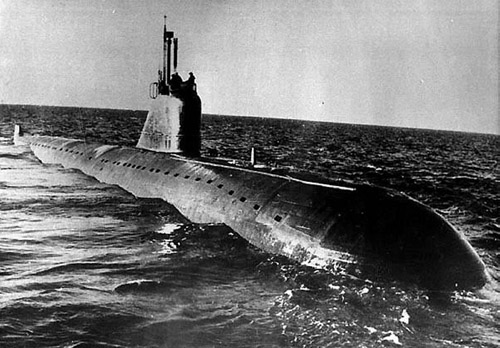
The November class, designated Project 627 Kit, was the Soviet Union's first class of nuclear-powered attack submarines. Development began following a 1952 requirement for a vessel capable of delivering nuclear-tipped torpedoes against coastal installations. During the development process, the operational role shifted from strategic strikes to the interception of warships and transport vessels on oceanic routes.
The class uses a double-hulled construction with streamlined stern fins and multiple internal compartments. Project 627A, the standard production variant, incorporates a bow sonar dome and a hydrophone antenna. One unit, K-27, was built as Project 645 featuring a cone-shaped hull and liquid metal-cooled reactors. Noise reduction measures include variable-pitch propellers, vibration dampening, and anti-sonar hull coatings. Sensors include sonar systems for target detection, hydroacoustic communication, and obstacle avoidance, supplemented by surface detection and reconnaissance radars.
Fourteen units entered service between 1959 and 1964. These submarines were assigned to the Northern Fleet, though four were later transferred to the Pacific Fleet. Transfers to the Pacific were conducted via Arctic under-ice voyages or southern routes through the Drake Strait. Early operations were restricted by steam generator reliability issues. As mechanical reliability improved, the class conducted regular patrols in the Atlantic and Arctic Oceans to track nuclear delivery vessels.
Operational history includes several losses and accidents. K-8 sank in the Bay of Biscay in 1970 following a fire during a naval exercise. K-27 was scuttled in the Kara Sea in 1982 after a reactor failure occurred in 1968. Other units experienced onboard fires or radioactive emissions during maintenance and patrols. The class was decommissioned between 1986 and 1990. While most units were scrapped, K-3 was designated for preservation as a museum ship in Saint Petersburg. K-159 sank in 2003 while under tow for disposal.