Hanscom Air Force Base
Hanscom Air Force Base is an active joint civil-military airfield in Massachusetts, United States, operated by the US Air Force. Home to the 66th Air Base Group, Air Force Life Cycle Management Center.
Facility Details
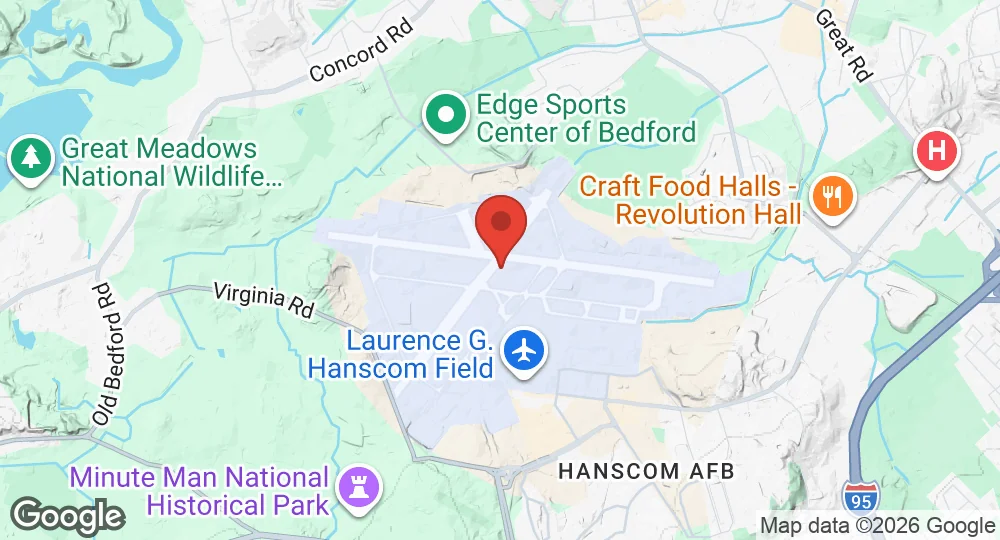
42.4700°N, 71.2892°W · 38 m elevation
| Operating Country | 🇺🇸 United States |
| Location | 🇺🇸 United States |
| Status | Active |
| Usage | Dual |
| Year built | 1941 |
| Operating Organization | US Air Force |
| Units |
66th Air Base GroupAir Force Life Cycle Management Center
|
| Elevation | 38 m (125 ft) |
| Website | www.hanscom.af.mil/ |
- 78 km Pease Air National Guard Base 157th Air Refueling Wing
- 98 km Quonset Point Air National Guard Station 143rd Airlift Wing
- 107 km Westover Air Reserve Base 439th Airlift Wing
- 110 km Otis Air National Guard Base 102nd Intelligence Wing
- 122 km Barnes Air National Guard Base 104th Fighter Wing
- 129 km Bradley Air National Guard Base 103rd Airlift Wing
 66th Air Base Group
 Air Force Life Cycle Management Center
Description
Hanscom Air Force Base is a Department of Defense facility located in Bedford, Lincoln, Concord, and Lexington, Massachusetts. The installation is situated adjacent to the civilian Hanscom Field. The site was established in 1941 as a Boston Auxiliary Airport and leased to the War Department in 1942.
During World War II, the base served as a training site for the 85th and 318th Fighter Squadrons, which operated P-40 Warhawks. It also functioned as a test site for radar technology developed by the MIT Radiation Laboratory. In 1943, the facility was named Laurence G. Hanscom Field. Post-war operations shifted toward the research and development of electronic systems. MIT Lincoln Laboratory was established at the installation in 1952, followed by the migration of the Air Force Cambridge Research Laboratories to the site in 1954. The Electronic Systems Division was established at Hanscom in 1961 to centralize the management of electronic systems. Military flying operations ceased in 1973, and the airfield portion of the facility reverted to state control in 1974.
The base is currently operated by the Air Force Materiel Command (AFMC) and functions as part of the Air Force Life Cycle Management Center (AFLCMC). The 66th Air Base Group serves as the host unit. Hanscom AFB provides facilities for the Program Executive Offices for Battle Management; Command, Control, Communications, Intelligence and Networks (C3I&N); and Nuclear Command, Control and Communications (NC3).
Units based at the installation include the 66th Force Support Squadron, 66th Medical Squadron, 66th Security Forces Squadron, and the 319th Recruiting Squadron. The base also supports the Massachusetts National Guard Joint Force Headquarters, the Massachusetts Wing Civil Air Patrol, MIT Lincoln Laboratory, and MITRE. Infrastructure includes specialized laboratories and the Hanscom School, which provides K-8 education. As a non-flying base, its primary role is the life cycle management of Air Force weapon systems.
- AUG 132026 Updated Aerodrome elevation sourced from OpenStreetMap
- APR 112026 Updated Description updated in a site-wide editorial pass
- JAN 122026 Updated Sources and cross-references refreshed
- JUL 12025 Updated Airbase data reviewed and updated