C-160 Transall
Summary
| Category | Military Transport Aircraft |
| Origin country | 🇩🇪 Germany • 🇫🇷 France |
| Manufacturer | Transall |
| First flight | 25 February 1963 |
| Year introduced | 1967 |
| Number produced | 214 units |
| Average unit price | $12 million |
Technical specifications
| Version: C-160F | |
|---|---|
| Crew | 2 pilots + 3 |
| Operational range | 1,853 km (1,151 mi) |
| Maximum speed | 513 km/h (319 mph) |
| Wing area | 160 m² (1722.2 sqft) |
| Wingspan | 40 m (131.2 ft) |
| Height | 11.7 m (38.2 ft) |
| Length | 32.4 m (106.3 ft) |
| Service ceiling | 8,230 m (27,001 ft) |
| Empty weight | 29,000 kg (63,934 lbs) |
| Max. takeoff weight | 51,000 kg (112,436 lbs) |
| Climb rate | 6.6 m/s (21.7 ft/s) |
| Powerplant | 2 x turboprops Rolls-Royce Tyne Rty.20 Mk 22 delivering 4549 kW each |
Current operating countries
All operators
Description
In the late 1950s, France and Germany sought to replace their aging piston-engined Nord Noratlas transports, leading to an agreement signed on 28 November 1957, to develop a successor. Italy was initially involved, but later withdrew. In January 1959, the "Transporter-Allianz," or Transall consortium, was formed between Nord Aviation (France), Weser Flugzeugbau (later VFW), and Hamburger Flugzeugbau (HFB) (Germany), to design and construct the new transport aircraft. The aircraft needed to carry a 16,000 kg cargo over 1,720 km, operate from semi-prepared airstrips, and have dimensions compatible with international railway loading gauges. Each production partner built a prototype; the first, by Nord, flew on 25 February 1963, followed by the VFW and HFB prototypes on 25 May 1963, and 19 February 1964, respectively. Six pre-production examples, stretched by 51 centimeters compared to the prototypes, flew between 1965 and 1966.
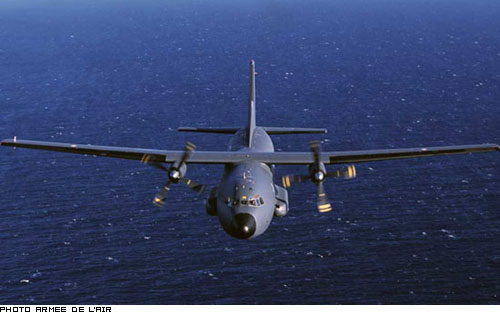
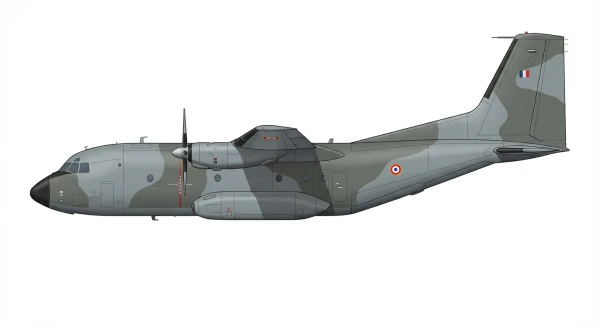
The Transall C-160 is a twin-engine tactical transport aircraft characterized by its cargo hold, rear-access ramp located beneath an upswept tail, and a high-mounted wing. It is powered by two Rolls-Royce Tyne turboprop engines driving four-bladed Dowty Rotol propellers. The aircraft is designed to execute cargo and troop transport, as well as aerial delivery of supplies and equipment. The cargo area is pressurised and maintained at a constant temperature using integrated air conditioning systems. The landing gear's ability to partially retract while on the ground effectively lowers the aircraft to facilitate easier vehicle loading. The C-160 is suited to tactical operations due to its short airfield performance, including its capacity to perform steep descents up to 20 degrees and land on airstrips as short as 400 meters. The Transall C-160 is primarily a transport aircraft.
The C-160 is capable of carrying a substantial payload, with a maximum of 16,000 kg (35,274 lb). This weight could include troops, cargo, or paratroopers. Depending on the configuration, the C-160 can accommodate 93 equipped troops or between 61 and 88 paratroopers. The aircraft's cargo compartment measures 17.20 m (56.4 ft) in length, 3.15 m (10.3 ft) in width, and 2.98 m (9 ft 9.3 in) in height. Some C-160s were modified for specialized roles, such as signals intelligence (SIGINT).
The C-160 has seen extensive operational use across various theaters and conflicts. In July 1974, the Turkish Air Force deployed seven C-160Ds during the invasion of Cyprus for troop transport, paratrooper drops, and supply delivery. The French Air Force utilized twelve C-160s in April 1976 during Operation Verveine, airlifting Moroccan troops and equipment to Zaïre amidst a border conflict with Angola, and in May 1978, C-160s dropped paratroopers of the French Foreign Legion during the Battle of Kolwezi. Throughout the South African Border War in the late 1980s, the South African Air Force's C-160s were critical in deploying and supplying troops, with one notable mission involving the transport of a captured SA-8 missile system from Angola to South Africa due to its larger cargo hold. The C-160 has also supported peacekeeping efforts in Sudan and Afghanistan and played a role in Operation Serval in Mali. Both humanitarian and military operations have seen the C-160 deployed in countries such as Mauritania, Niger, Chad, Ethiopia, Bosnia, and Lebanon. In French service, tanker variants proved valuable in supporting operations in Africa and SIGINT-equipped C-160Gs supplemented Boeing E-3 Sentry AWACS aircraft. Notably, in 1991, a SIGINT-equipped C-160G supported Coalition forces during and after the Gulf War.
Main Variants:
-
C-160D: This was the production aircraft for the West German Air Force, with 110 units built, some of which were later fitted with a self-protection suite called ESS.
-
C-160F: This variant was the production aircraft for the French Air and Space Force, with a total of 50 units manufactured.
-
C-160P: This was a conversion of four C-160Fs modified for use by the French Postal Service for air mail transport.
-
C-160Z: This version was specifically produced for the South African Air Force, with nine aircraft delivered.
-
C-160G Gabriel: This was a SIGINT (signals intelligence) aircraft employed by the French Air Force, easily identifiable by the distinctive antennas fitted to the airframe.