HPT-32 Deepak
Indian prop-driven primary trainer, developed in the late 20th century, used for basic pilot training, observation, and liaison by the Indian armed forces. Key figures: top speed 281 km/h, range 1,400 km, service ceiling 5,500 m, max takeoff weight 1,322 kg.
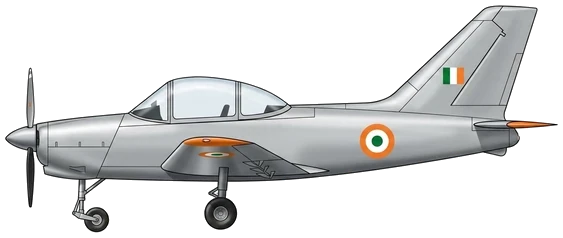
| Crew | 2 (student, instructor) |
| Length | 7.7 m (25.3 ft) |
| Wingspan | 9.5 m (31.2 ft) |
| Height | 2.9 m (9.5 ft) |
| Wing area | 15 m² (161.5 sqft) |
| Empty weight | 1,034 kg (2,280 lbs) |
| Max. takeoff weight | 1,322 kg (2,915 lbs) |
| Powerplant | 1 × Lycoming AEO-540-D4B5 piston engine 194 kW each |
| Maximum speed | 281 km/h (175 mph) |
| Operational range | 1,400 km (870 mi) |
| Service ceiling | 5,500 m (18,045 ft) |
| Climb rate | 5.6 m/s (18.4 ft/s) |
Description
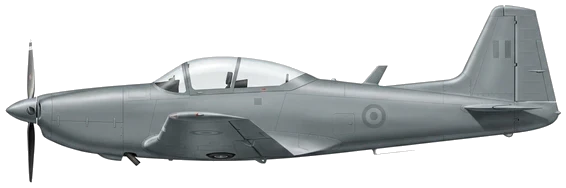
The HAL HPT-32 Deepak is an Indian low-wing, monoplane, single-engine primary trainer manufactured by Hindustan Aeronautics Limited (HAL) for basic pilot training in aerobatics, navigation, and flying skills.
Design
The aircraft accommodates a student and an instructor in a side-by-side two-seat configuration. It has a length of 7.7 m, a wingspan of 9.5 m, a height of 2.9 m, and a wing area of 15.0 m². The HPT-32 is powered by a 260 hp (194 kW) Lycoming AEO-540-D4B5 piston engine, yielding a maximum speed of 281 km/h, a range of 1,400 km, a rate of climb of 1,100 ft/min, and a service ceiling of 18,045 ft. Its empty weight is 1,034 kg, and its maximum takeoff weight is 1,322 kg.
The aircraft has a theoretical glide ratio of 8.5:1. Inverted flight is limited to one minute, during which fuel is supplied from a collector tank in the fuselage. To mitigate engine failure risks, the Indian Air Force cleared the installation of a parachute recovery system on 16 May 2010. For light offensive and training roles, the HPT-32 features four hardpoints with a total payload capacity of 255 kg, which can carry machine gun pods, bombs, and rockets.
Operational History
The Indian Air Force acquired 144 HPT-32 aircraft, and the Indian Navy acquired eight. Beyond primary training, the type performed observation, liaison, and target towing missions. During its service career, the aircraft suffered from engine issues, resulting in 17 crashes and 19 pilot fatalities. The Comptroller and Auditor General of India declared the aircraft technologically outdated and safety-hazard prone when the fleet was grounded in 2009. The Indian Air Force subsequently replaced the HPT-32 with the Pilatus PC-7 Mk II as its basic trainer in 2013, with the HAL HTT-40 designated as the eventual replacement.
Variants
- HPT-32: The basic version, powered by a Textron Lycoming EIO-540-D4B5 flat-six piston engine.
- HTT-34: A turboprop version powered by a 310 kW (420 shp) Allison 250-B17D engine, which first flew on 17 June 1984.
Frequently Asked Questions
What type of aircraft is the HPT-32 Deepak?
What is the maximum speed of the HPT-32 Deepak?
What is the range of the HPT-32 Deepak?
When did the HPT-32 Deepak first fly?
Which countries operate the HPT-32 Deepak?
What is the service ceiling of the HPT-32 Deepak?
- JUL 12026 Created Page created: HPT-32 Deepak