Robinson R22
Summary
| Category | Military Training Aircraft |
| Origin country | 🇺🇸 United States |
| Manufacturer | Robinson |
| First flight | 28 August 1975 |
| Year introduced | 1979 |
| Number produced | 4600 units |
| Average unit price | $0.4 million |
Technical specifications
| Version: R22 | |
|---|---|
| Crew | 1 pilot |
| Operational range | 387 km (240 mi) |
| Maximum speed | 188 km/h (117 mph) |
| Wingspan | 7.7 m (25.2 ft) |
| Height | 2.5 m (8.1 ft) |
| Length | 8.8 m (28.8 ft) |
| Service ceiling | 4,267 m (13,999 ft) |
| Empty weight | 361 kg (796 lbs) |
| Max. takeoff weight | 621 kg (1,369 lbs) |
| Climb rate | 6.1 m/s (20.0 ft/s) |
| Powerplant | 1 x radial engine Lycoming O-320-A2B delivering 93 kW each |
Current operating countries
| Country | Units | ||
|---|---|---|---|

|
Dominican Republic | 3 | |

|
Philippines | 2 | |
All operators
Description
The Robinson R22 was designed in 1973 by Frank D. Robinson, with flight testing primarily conducted at Zamperini Field in Torrance, California. Flight testing and certification were performed in the late 1970s by test pilot Joseph John "Tym" Tymczyszyn. The R22 received FAA certification in March 1979. The first R22 sold, S/N 003, N1010WR, was purchased in October 1979 by Pacific Wing and Rotor, Inc. The initial prototype, S/N 001, crashed during certification testing due to a failure in the tail rotor gearbox casting, and S/N 002 was subsequently used to complete FAA certification; S/N 002 is preserved in the collection of the Smithsonian Air and Space Museum. By 2019, approximately 4800 R22s had been produced.
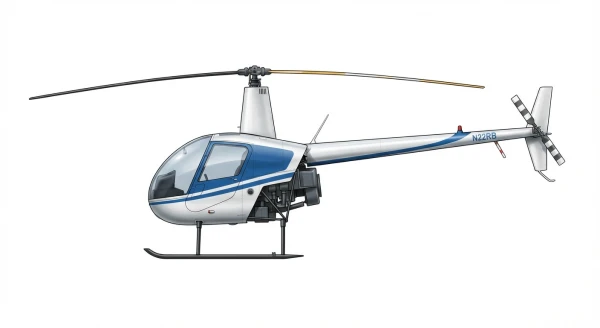
The R22 is a light, two-place helicopter powered by a single reciprocating engine, featuring a semi-rigid, two-bladed main rotor with a teetering hinge and two coning hinges, and a two-bladed tail rotor with only a teetering hinge. The primary structure consists of welded chromoly steel tubing, while the forward fuselage incorporates fiberglass and aluminum, along with a Plexiglas canopy; the tailcone, vertical, and horizontal stabilizers are constructed from aluminum. Inside, the enclosed cabin offers side-by-side seating for a pilot and passenger, with removable doors. Instead of traditional floor-mounted cyclic sticks, the R22 employs a teetering "T-Bar" control that emerges from the console between the seats. To simplify pilot workload, a mechanical throttle correlator adjusts the throttle in conjunction with the collective pitch control, and later models include an electronic governor to maintain engine speed.
The Robinson R22 is primarily a light utility helicopter and is not typically configured for offensive armament. Its primary function revolves around training, personal transportation, and utility roles such as livestock management. It lacks any internal weapons bays or hardpoints for external stores. Specific configurations may exist for law enforcement purposes, such as the R22 Beta II Police variant equipped with a searchlight and loudspeaker, these do not involve lethal weaponry. The helicopter's maximum takeoff weight is 1,370 lb (621 kg), which caters to its crew, fuel, and limited cargo capacity.
The Robinson R22 has seen widespread use across various sectors since its introduction. Its relatively low cost and operating expenses have made it a choice for primary rotorcraft training globally, as well as for personal use and livestock management, particularly on large ranches in North America and cattle stations in Australia. Several broadcasters utilized the R22 until the mid-1990s. Beyond civilian applications, the R22 has also found a niche in military and government roles, serving with the Croatian Police, Dominican Republic Army, Philippine Navy, and Turkish Land Forces. Its service with the Philippine Navy ended after the last R22 model helicopter in their inventory crashed on April 11, 2024.
Main Variants:
-
R22: The initial production version, it is powered by a Lycoming O-320-A2B or A2C piston engine.
-
R22 HP: A higher-powered version, it features a 160 bhp Lycoming O-320-B2C piston engine.
-
R22 Alpha: This improved version, certified in 1983, is powered by a Lycoming O-320-B2C piston engine.
-
R22 Beta: Fitted with a more powerful engine, it is powered by a Lycoming O-320-B2C piston engine.
-
R22 Beta II: Fitted with a larger Lycoming O-360 engine derated for sea-level operation, it allows greater altitudes for hovering in and out of ground effect (HIGE/HOGE).