Robinson R22
American light, multi-purpose helicopter, widely used for flight training, livestock mustering, and patrol from the late 20th century. Key figures: top speed 188 km/h, range 387 km, service ceiling 4,267 m, max takeoff weight 621 kg, unit price $0.4M, built 4,600. In service with 1 air force as of 2026 — Dominican Republic (4).
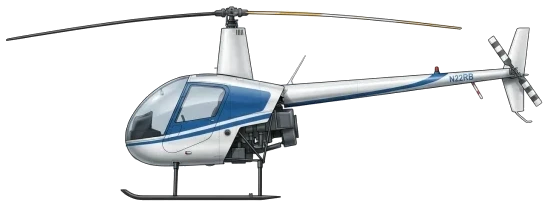
| Crew | 1 |
| Length | 8.8 m (28.8 ft) |
| Wingspan | 7.7 m (25.2 ft) |
| Height | 2.5 m (8.1 ft) |
| Empty weight | 361 kg (796 lbs) |
| Max. takeoff weight | 621 kg (1,369 lbs) |
| Powerplant | 1 × radial engine Lycoming O-320-A2B 93 kW each |
| Maximum speed | 188 km/h (117 mph) |
| Operational range | 387 km (240 mi) |
| Service ceiling | 4,267 m (13,999 ft) |
| Climb rate | 6.1 m/s (20.0 ft/s) |

Description
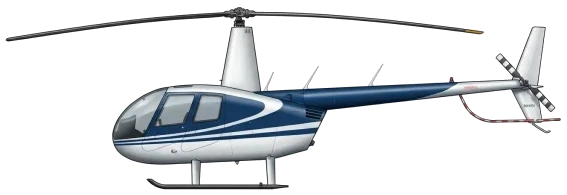
The Robinson R22 is a two-seat, single-engined light utility helicopter built by the Robinson Helicopter Company of Torrance, California. Designed by Frank D. Robinson in 1973, it received FAA certification in March 1979 and has been in production since that year. It is used chiefly as a primary rotorcraft trainer, entry-level private helicopter, and livestock-mustering platform, and forms the basis of the Boeing Maverick unmanned helicopter.
Development
Most flight testing took place at Zamperini Field, Torrance, with certification flying conducted in the late 1970s by test pilot Joseph John "Tym" Tymczyszyn. Serial 001 was lost in the ocean during certification testing after failure of the casting joining the tail rotor gearbox and stabilising fins to the aluminium tail boom; S/N 002 (N32AD) completed certification and is preserved in the Smithsonian collection. The first aircraft sold, S/N 003 (N1010WR), went to Pacific Wing and Rotor in October 1979 for US$48,000 including options, against a projected 1977 price of US$18,000–19,000. In late 1981 the type certificate was temporarily revoked after main rotor blade delamination traced to contamination during priming at an outside vendor; all blades on the 33 aircraft then in service were replaced. Robinson established the Robinson Pilot Safety Course in 1982; the fatal accident rate fell from 6.0 per 100,000 flight hours in 1982 to 0.7 in 1997. By 2019, 4,800 R22s had been built. The Beta II had a suggested retail price of US$375,000 as of 15 January 2024.
Design
The R22 has a semirigid two-bladed main rotor with a teetering hinge and two coning hinges, and a two-bladed teetering tail rotor, both driven through pushrods without hydraulic assistance. The basic structure is welded chromoly steel tubing, with a fibreglass and aluminium forward fuselage, Plexiglas canopy, and aluminium tailcone and stabilisers. Control is by a teetering "T-bar" cyclic emerging from the centre console rather than floor-mounted sticks. The original aircraft used a 124 hp Lycoming O-320-A2B or -A2C; the Beta II uses an O-360-J2A derated at sea level to preserve high-altitude hover performance without forced induction. Power passes through two dual V-belts (four separate V-belts on early aircraft, which proved prone to rolling in their grooves) and a one-way sprag clutch permitting autorotation, with a target autorotation speed of 65 kn and roughly 4:1 glide ratio. Landing gear is skid type; the Mariner used floats. Maximum take-off weight is 1,370 lb, cruise speed 96 kn, range 209 nmi and service ceiling 14,000 ft.
Operational History
The R22 is flown by private owners, companies and flying clubs. In Australia, 489 were registered by mid-2011, with 62% of fleet hours flown on mustering and 13% on training. US broadcasters used the type for news gathering until the mid-1990s. Military and government operators include the Croatian Police, Dominican Republic Army, Philippine Navy and Turkish Land Forces. In 2003 the US Navy bought four Boeing Maverick unmanned R22s fitted with Wescam electro-optical/infrared systems; one was modified as the DARPA-contracted Renegade testbed, first flying under software enabled control on 26 May 2005. The Philippine Navy's last R22 crashed at Cavite City on 11 April 2024, killing both pilots.
Variants
- R22: Initial production version powered by a Lycoming O-320-A2B or -A2C.
- R22 HP: Higher-powered model with a 160 bhp Lycoming O-320-B2C.
- R22 Alpha: Certified in 1983, with extended aft landing gear mounting points and an O-320-B2C.
- R22 Beta: Added optional engine governor, rotor brake, optional auxiliary tank and relocated battery.
- R22 Beta II: Fitted with the O-360-J2A, standard governor and carburettor heat assist.
Frequently Asked Questions
What type of aircraft is the Robinson R22?
What is the maximum speed of the Robinson R22?
What is the range of the Robinson R22?
When did the Robinson R22 first fly?
How many Robinson R22 have been built?
Which countries operate the Robinson R22?
How much does a Robinson R22 cost?
What is the service ceiling of the Robinson R22?
- AUG 302026 Updated Description updated
- JUL 272026 Updated Name updated
- JUL 232026 Updated Sources and cross-references refreshed
- APR 72026 Updated Sources and cross-references refreshed
- FEB 72026 Updated Wingspan added
- JAN 122026 Updated Range updated in a site-wide editorial pass